

Electric Potential Formula: 8 Core Equations, Units, and Worked Examples for Point Charges, Uniform Fields, and Charge Distributions
What Is the Electric Potential Formula?
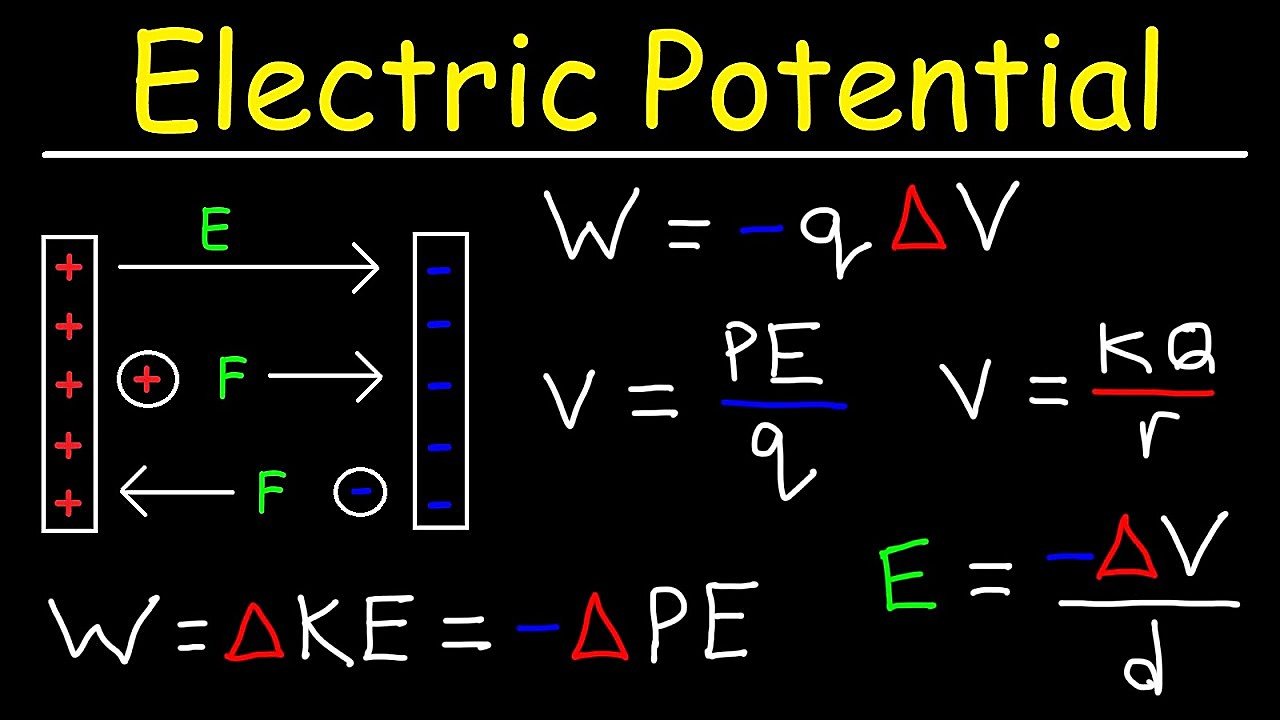
The electric potential formula is V = U/q, where V is the electric potential in volts, U is the electric potential energy in joules, and q is the test charge in coulombs. For a single point charge, the formula becomes V = kq/r.
For a reliable reference, consult OpenStax section on electric force and Coulomb’s law.
Electric potential is the electric potential energy per unit charge at a point in an electric field. It is a scalar quantity. Scalar quantities include temperature, mass, and energy. A point 0.30 m from a 5 nC charge has an electric potential of about 150 V.
What Do the Symbols in the Electric Potential Formula Mean?
The electric potential formulas use 8 main symbols. The table below defines each symbol. Rows represent symbols. Columns show the quantity, the SI unit, and a typical value or note.
| Symbol | Quantity | SI Unit | Typical Value or Note |
|---|---|---|---|
| V | Electric potential | volt (V) | 150 V at 0.30 m from a 5 nC charge |
| U | Electric potential energy | joule (J) | 3.0 × 10⁻⁷ J for a 2 nC charge at that point |
| q | Charge | coulomb (C) | Electron charge: −1.602 × 10⁻¹⁹ C |
| k | Coulomb constant | N·m²/C² | 8.99 × 10⁹ N·m²/C² |
| ε₀ | Vacuum permittivity | F/m | 8.85 × 10⁻¹² F/m |
| r | Distance from the charge | metre (m) | Measured from the centre of the charge |
| E | Electric field strength | V/m or N/C | 500 V/m in the uniform field example |
| d | Distance along the field | metre (m) | 0.04 m in the uniform field example |
According to NIST CODATA 2018 values, k is 8.9875517923 × 10⁹ N·m²/C² and ε₀ is 8.8541878128 × 10⁻¹² F/m. The two constants are linked by k = 1/(4πε₀).
What Is the Unit of Electric Potential?
The SI unit of electric potential is the volt (V), which equals 1 joule per coulomb (1 J/C). The unit is named after Alessandro Volta, who invented the voltaic pile in 1800. One volt also equals 1 N·m/C.
Common volt prefixes include 3 units:
- Millivolt (1 mV = 10⁻³ V)
- Kilovolt (1 kV = 10³ V)
- Megavolt (1 MV = 10⁶ V)
What Are the 8 Core Electric Potential Formulas?
The 8 core electric potential formulas cover the definition, point charges, multiple charges, potential difference, uniform fields, the field relation, continuous distributions, and dipoles. The table below lists each formula with its use. Rows represent formulas. Columns show the situation, the formula, and the meaning of the result.
| No. | Situation | Formula | Meaning |
|---|---|---|---|
| 1 | General definition | V = U/q | Potential energy per unit charge |
| 2 | Point charge | V = kq/r | Potential at distance r from charge q |
| 3 | Multiple point charges | V = k Σ (qᵢ/rᵢ) | Scalar sum of each charge's potential |
| 4 | Potential difference | ΔV = V(B) − V(A) = ΔU/q | Change in potential between 2 points |
| 5 | Uniform electric field | ΔV = Ed | Potential change over distance d |
| 6 | Field from potential | E = −dV/dx | Field equals the negative potential gradient |
| 7 | Continuous charge | V = k ∫ dq/r | Sum of potentials from all charge elements |
| 8 | Electric dipole | V = kp cosθ / r² | Potential far from a dipole of moment p |
What Is the Formula for Electric Potential Due to a Point Charge?
The electric potential due to a point charge is V = kq/r, where k is 8.99 × 10⁹ N·m²/C², q is the charge in coulombs, and r is the distance in metres. An equivalent form is V = q/(4πε₀r). The reference point V = 0 is set at infinite distance.
Follow these 4 steps to calculate the potential of a point charge:
- Convert the charge to coulombs.
- Convert the distance to metres.
- Multiply k by q.
- Divide the result by r.
Worked example: a 5 nC charge sits 0.30 m from a point. V = (8.99 × 10⁹ × 5 × 10⁻⁹) ÷ 0.30 = 44.95 ÷ 0.30 ≈ 150 V.
What Is the Formula for Electric Potential Due to Multiple Charges?
The electric potential due to multiple charges is the scalar sum of the potential from each charge: V = k(q₁/r₁ + q₂/r₂ + … + qₙ/rₙ). This rule is the superposition principle. Potentials add as numbers with signs, not as vectors with directions.
Worked example: point P is 0.30 m from a +6 μC charge and 0.20 m from a −2 μC charge.
- Potential from +6 μC: (8.99 × 10⁹ × 6 × 10⁻⁶) ÷ 0.30 = +179,800 V
- Potential from −2 μC: (8.99 × 10⁹ × −2 × 10⁻⁶) ÷ 0.20 = −89,900 V
- Total potential: 179,800 − 89,900 = 89,900 V, or about 9.0 × 10⁴ V
What Is the Formula for Electric Potential Difference?
Electric potential difference is ΔV = V(B) − V(A) = ΔU/q, and the work done on a charge q through ΔV is W = qΔV. The unit is the volt. Potential difference is also called voltage.
Worked example: an electron moves through a potential difference of 100 V from rest. The kinetic energy gained is 1.602 × 10⁻¹⁹ C × 100 V = 1.602 × 10⁻¹⁷ J. The speed is v = √(2qV/m) = √(2 × 1.602 × 10⁻¹⁷ ÷ 9.109 × 10⁻³¹) ≈ 5.93 × 10⁶ m/s.
One electron volt (eV) is the energy gained by an electron moving through 1 V. Its value is 1.602 × 10⁻¹⁹ J.
What Is the Formula for Electric Potential in a Uniform Electric Field?
The potential difference in a uniform electric field is ΔV = Ed, where E is the field strength in V/m and d is the distance along the field in metres. Potential decreases in the direction of the field.
Worked example: E = 500 V/m and d = 0.04 m give ΔV = 500 × 0.04 = 20 V. Parallel plates with 12 V across a 0.006 m gap have a field of 12 ÷ 0.006 = 2,000 V/m.
What Is the Relationship Between Electric Field and Electric Potential?
The electric field equals the negative rate of change of electric potential with position: E = −dV/dx. In three dimensions, the relation is E = −∇V. The field points from high potential to low potential. The unit of E is V/m, which equals N/C.
The reverse relation is V = −∫E · dl. This integral gives the potential from a known field. [internal link: Electric Field Formula]
What Is the Formula for Electric Potential of a Continuous Charge Distribution?
The electric potential of a continuous charge distribution is V = k ∫ dq/r, where dq is a small charge element and r is its distance from the point. The integral sums the contribution of every element. The table below lists results for 6 common shapes. Rows represent shapes. Columns show the location and the formula.
| Shape | Location | Formula |
|---|---|---|
| Ring of radius R and charge Q | On the axis at distance x | V = kQ / √(R² + x²) |
| Disk of radius R and surface charge σ | On the axis at distance x | V = (σ/2ε₀)(√(R² + x²) − x) |
| Conducting sphere of radius R | Outside, r ≥ R | V = kQ/r |
| Conducting sphere of radius R | Inside, r ≤ R | V = kQ/R (constant) |
| Uniformly charged insulating sphere | Inside, r ≤ R | V = kQ(3R² − r²) / (2R³) |
| Infinite line with charge density λ | Distance r, reference r₀ | V = −(λ/2πε₀) ln(r/r₀) |
An infinite line needs a reference distance r₀ because the potential does not settle to zero at infinity.
What Is the Electric Potential Formula for an Electric Dipole?
The electric potential of a dipole at distance r is V = kp cosθ / r², where p = qd is the dipole moment and θ is the angle from the dipole axis. The formula applies when r is much larger than the charge separation d. The potential is zero along the equatorial line (θ = 90°).
How Is the Electric Potential Formula Derived?
The electric potential formula for a point charge is derived by integrating the electric field from infinity to distance r. Follow these 4 steps:
- Start with the field of a point charge from Coulomb's law: E = kq/r².
- Define potential through the field: V(r) = −∫ E dr, taken from infinity to r.
- Set the reference potential to zero at infinity.
- Integrate: V(r) = −∫ (kq/r′²) dr′ = kq/r.
Charles-Augustin de Coulomb published the inverse-square law in 1785. [internal link: Coulomb's Law Formula]
What Is the Difference Between Electric Potential and Electric Potential Energy?
Electric potential is the energy per unit charge at a point, and electric potential energy is the total energy a specific charge has at that point. The relation is U = qV. The table below compares 5 aspects. Rows represent aspects. Columns show electric potential and electric potential energy.
| Aspect | Electric Potential | Electric Potential Energy |
|---|---|---|
| Symbol | V | U |
| Definition | Energy per unit charge | Energy of a given charge |
| Point charge formula | V = kq/r | U = kq₁q₂/r |
| SI unit | volt (V) | joule (J) |
| Depends on the test charge | No | Yes |
Example: a 2 nC charge at a point with 150 V has U = 2 × 10⁻⁹ × 150 = 3.0 × 10⁻⁷ J. [internal link: Electric Potential Energy Formula]
What Is the Difference Between Electric Potential and Voltage?
Voltage is the electric potential difference between 2 points. Both quantities use the volt. Examples include a 1.5 V AA battery, a 12 V car battery, and the 230 V household supply in Nigeria. In circuits, voltage links to current and resistance through V = IR.
What Are Equipotential Surfaces?
Equipotential surfaces are surfaces where the electric potential has the same value at every point. No work is done when a charge moves along such a surface. The surfaces are perpendicular to electric field lines. Two common shapes are:
- Concentric spheres around a point charge
- Parallel planes in a uniform field
What Is the Sign Convention for Electric Potential?
The electric potential is positive near a positive charge and negative near a negative charge. The reference point is V = 0 at infinity. Three rules apply:
- Potential decreases when moving away from a positive charge.
- Potential increases when moving away from a negative charge.
- Potential from several charges adds with signs included.
What Are Common Mistakes When Using the Electric Potential Formula?
Five mistakes cause most errors in electric potential problems:
- Omitting the sign of the charge
- Adding potentials as vectors
- Using centimetres or microcoulombs without conversion
- Confusing potential with potential energy
- Measuring r from the wrong point
Where Is the Electric Potential Formula Used?
The electric potential formula is used in capacitors, circuits, particle acceleration, and biological signals. Four applications are listed below:
- Capacitors: the relation V = Q/C links stored charge to voltage, and the stored energy is ½CV².
- Circuits: Ohm's law, V = IR, links voltage to current and resistance.
- Particle acceleration: a charge q gains kinetic energy equal to qV when crossing a potential difference V.
- Biological signals: neurons maintain a resting potential of about −70 mV, and an ECG records potential differences of about 1 mV. [internal link: Impulse Definition]
What Is the Electric Potential Formula in Summary?
The electric potential formula is V = U/q in general and V = kq/r for a point charge. The 8 core equations cover point charges, multiple charges, potential difference, uniform fields, the field relation, continuous charges, and dipoles. The volt is the SI unit. Electric potential is a scalar, and potentials from several charges add as signed numbers.
People Also Ask About the Electric Potential Formula
What is the formula for electric potential?
The formula for electric potential is V = U/q, which equals electric potential energy divided by charge.
What is the formula for electric potential due to a point charge?
The formula is V = kq/r, where k is 8.99 × 10⁹ N·m²/C².
What is the SI unit of electric potential?
The SI unit of electric potential is the volt, which equals 1 joule per coulomb.
Is electric potential a scalar or a vector?
Electric potential is a scalar because it has magnitude and sign but no direction.
What is the formula for potential difference?
The formula for potential difference is ΔV = V(B) − V(A) = ΔU/q.
What is the relation between electric field and electric potential?
The electric field equals the negative gradient of the potential: E = −dV/dx.
What is the electric potential at the centre of a charged ring?
The electric potential at the centre of a charged ring is V = kQ/R.
What is the electric potential on the equatorial line of a dipole?
The electric potential on the equatorial line of a dipole is zero.
What is 1 volt?
One volt is the potential difference that gives 1 joule of energy to 1 coulomb of charge.

The University of the West Indies
My passion as a teacher and leader in education is to contribute to students’ enhanced learning by creation of a positive teaching/learning environment, where they are motivated to develop strong critical thinking, analytical and problem-solving skills.
As acting Vice-Principal and head of Physics, I have amassed five years of experience in leading meetings, implementing strategies to maintain discipline and school ethos, liaise with stakeholders in planning for future development of the institution; successfully negotiated the implementation of various projects for student development as well as supervising effective execution of such. For the past 19 years, I have incorporated discovery learning within the classroom through practical activities, problem solving and cooperative learning and have realized that students retention in Physics and Mathematics have increased significantly.
I am always cognizant that students have different learning styles, and as such teaching strategies during planning and delivery must take this crucial factor into consideration and be tailored to meet such differences.