

How Do You Work Out Displacement, and Which Formulas, Units, and Examples Apply?
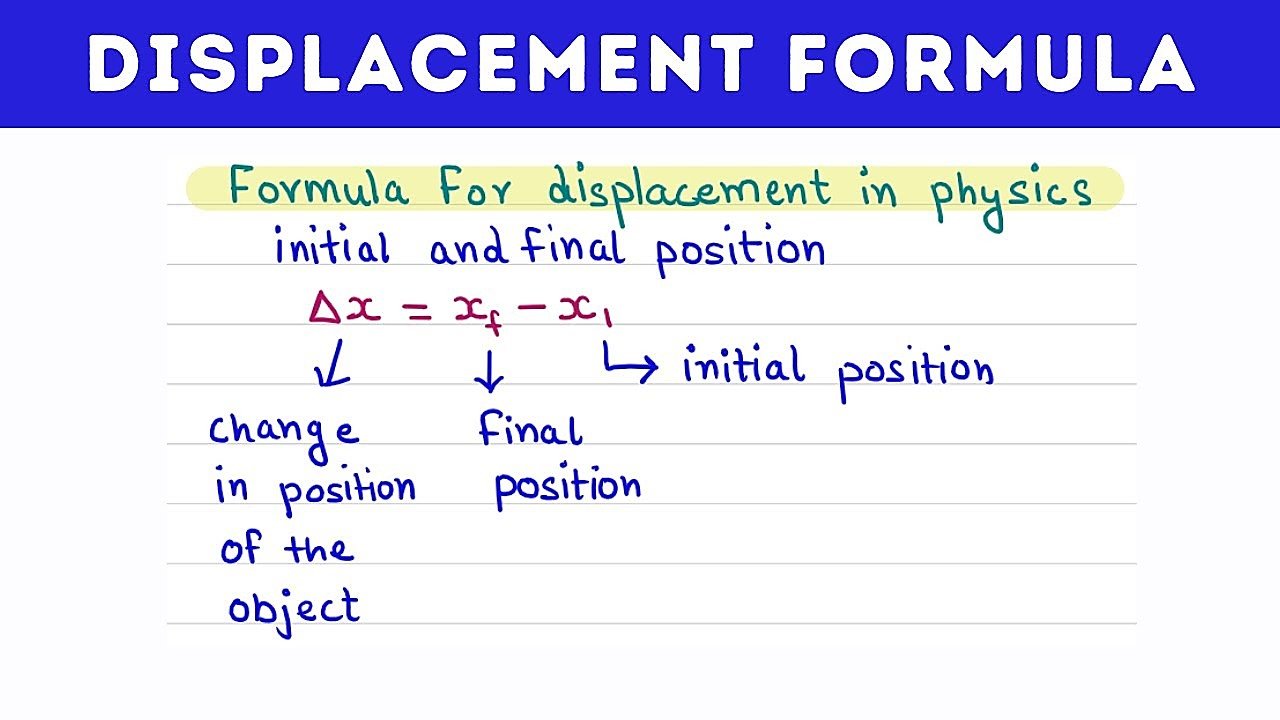
Work out displacement by subtracting the initial position from the final position, Δx = x_f − x_i. Displacement is a vector quantity with magnitude and direction, and the SI unit is the meter (m). In 2 or 3 dimensions, combine the component displacements with the Pythagorean theorem. Other methods use velocity and time (Δx = vt), constant acceleration (Δx = v₀t + ½at²), the area under a velocity-time graph, and the integral Δx = ∫v dt.
For a reliable reference, consult OpenStax section on position and displacement.
What Is Displacement?
Displacement is the change in position of an object, measured as a straight-line vector from the start point to the end point. The symbols are Δx for one dimension and Δr for two or three dimensions. Some textbooks use s or d.
According to OpenStax University Physics Volume 1, displacement is the change in position of an object. Displacement has a magnitude, a direction, and a sign in one dimension. A displacement of +8 m east and a displacement of −8 m (8 m west) have the same magnitude and opposite directions.
How Do You Work Out Displacement?
Work out displacement in 5 steps: define, locate, subtract, combine, and state.
- Define the origin and the positive direction for each axis.
- Locate the initial position and the final position.
- Subtract the initial position from the final position.
- Combine the component displacements with the Pythagorean theorem, if the motion has 2 or 3 dimensions.
- State the magnitude, the direction, and the unit.
The path between the start point and the end point does not affect displacement. Only the 2 end positions determine the result.
Which Formulas Work Out Displacement?
The core formula is Δx = x_f − x_i, and the other formulas apply when velocity, acceleration, or graphs are known. The table lists 10 formulas and the known quantities that lead to each formula.
| Formula | Known Quantities | Use Case |
|---|---|---|
| Δx = x_f − x_i | Initial position x_i (m), final position x_f (m) | One-dimensional positions |
| Δr = r_f − r_i | Position vectors r_i and r_f (m) | Vector subtraction in 2D or 3D |
| |Δr| = √(Δx² + Δy² + Δz²) | Component displacements (m) | Magnitude from components |
| θ = tan⁻¹(Δy/Δx) | Components Δx and Δy (m) | Direction angle in 2D |
| Δx = vt | Constant velocity v (m/s), time t (s) | Motion at constant velocity |
| Δx = ½(v₀ + v)t | Initial velocity v₀ (m/s), final velocity v (m/s), time t (s) | Constant acceleration, no acceleration value |
| Δx = v₀t + ½at² | Initial velocity v₀ (m/s), acceleration a (m/s²), time t (s) | Constant acceleration, final velocity unknown |
| Δx = (v² − v₀²)/(2a) | v₀ (m/s), v (m/s), acceleration a (m/s²) | Constant acceleration, no time value |
| Δx = ∫v dt | Velocity function v(t) | Varying velocity, or area under a velocity-time graph |
| Δθ = ωt | Angular velocity ω (rad/s), time t (s) | Angular displacement at constant angular velocity |
What Is the Difference Between Displacement and Distance?
Displacement is a vector that measures the straight-line change in position, and distance is a scalar that measures the total path length.
The table compares the 2 quantities across 6 attributes.
| Attribute | Displacement | Distance |
|---|---|---|
| Quantity type | Vector | Scalar |
| Definition | Final position minus initial position | Total length of the path |
| Direction | Included | Not included |
| Sign | Positive, negative, or zero | Zero or positive |
| Dependence on path | Independent of the path | Dependent on the path |
| Round trip result | 0 m | Twice the one-way length |
The magnitude of displacement is less than or equal to the distance. The 2 values are equal for straight-line motion in one direction.
What Are the Units of Displacement?
The SI unit of displacement is the meter (m). Other units include kilometers, centimeters, miles, feet, and nautical miles.
The table converts 6 length units to meters.
| Unit | Symbol | Value in Meters |
|---|---|---|
| Meter | m | 1 |
| Kilometer | km | 1,000 |
| Centimeter | cm | 0.01 |
| Mile | mi | 1,609.344 |
| Foot | ft | 0.3048 |
| Nautical mile | nmi | 1,852 |
How Do Signs and Directions Work in Displacement?
A sign convention assigns positive values to one direction on an axis and negative values to the opposite direction. The sign of Δx indicates the direction of the net change in position.
| Direction | Sign |
|---|---|
| East or right | Positive |
| West or left | Negative |
| North or up | Positive |
| South or down | Negative |
A result of Δx = −35 m has a magnitude of 35 m and points in the negative direction.
How to Work Out Displacement in One Dimension?
Subtract the initial position from the final position, and the sign gives the direction.
Worked example 1: a runner moves from the 20 m mark to the 75 m mark on a straight track. Δx = 75 − 20 = +55 m.
Worked example 2: the runner then returns from the 75 m mark to the 40 m mark. Δx = 40 − 75 = −35 m, which means 35 m in the negative direction.
How to Work Out Displacement for Several Legs on a Line?
Add the signed displacements of all legs, or subtract the first position from the last position.
Worked example 3: a cart moves +40 m, then −15 m, then +10 m along a straight rail.
- Net displacement: 40 − 15 + 10 = +35 m
- Distance traveled: 40 + 15 + 10 = 65 m
How to Work Out Displacement for a Round Trip?
Displacement equals 0 m for any trip that ends at the starting point. Worked example 4: a runner completes one lap of a 400 m track.
- Displacement: x_f − x_i = 0 m
- Distance: 400 m
How to Work Out Displacement in Two or Three Dimensions?
Resolve each leg into components, add the components along each axis, and combine the totals with the Pythagorean theorem. The magnitude is |Δr| = √(Δx² + Δy²), and the direction is θ = tan⁻¹(Δy/Δx).
Worked example 5: a hiker walks 30 m east and then 40 m north.
- Magnitude: √(30² + 40²) = √2,500 = 50 m
- Direction: tan⁻¹(40/30) = 53.1 degrees north of east
Worked example 6: a hiker walks 60 m east and then 80 m at 60 degrees north of east.
- Horizontal total: 60 + 80 cos 60° = 60 + 40 = 100 m
- Vertical total: 80 sin 60° = 69.3 m
- Magnitude: √(100² + 69.3²) = 121.7 m
- Direction: tan⁻¹(69.3/100) = 34.7 degrees north of east
Worked example 7: a ship sails 10 km north, then 10 km east, then 4 km south.
- Eastward total: 10 km
- Northward total: 10 − 4 = 6 km
- Magnitude: √(10² + 6²) = √136 = 11.7 km
- Direction: tan⁻¹(6/10) = 31.0 degrees north of east, which equals a compass bearing of 059 degrees
Worked example 8: a drone flies 30 m east, 40 m north, and 120 m up.
- Magnitude: √(30² + 40² + 120²) = √16,900 = 130 m
How to Work Out Displacement From Velocity and Time?
Multiply velocity by time for constant velocity, Δx = vt, and multiply average velocity by time for any motion, Δx = v_avg Δt.
Worked example 9: a train moves at a constant 12 m/s for 25 s. Δx = 12 × 25 = 300 m in the direction of motion.
Worked example 10: a cyclist has an average velocity of 4.5 m/s east over 20 s. Δx = 4.5 × 20 = 90 m east.
How to Work Out Displacement With Constant Acceleration?
Use Δx = v₀t + ½at² when time is known, Δx = (v² − v₀²)/(2a) when time is unknown, and Δx = ½(v₀ + v)t when both velocities are known.
The table lists 4 formulas and the quantity that each formula omits.
| Formula | Omitted Quantity |
|---|---|
| Δx = v₀t + ½at² | Final velocity v |
| Δx = vt − ½at² | Initial velocity v₀ |
| Δx = ½(v₀ + v)t | Acceleration a |
| Δx = (v² − v₀²)/(2a) | Time t |
Worked example 11: a car starts from rest and accelerates at 3.0 m/s² for 8.0 s.
- Formula: Δx = v₀t + ½at²
- Substitution: Δx = 0 + ½ × 3.0 × 8.0² = 96 m
Worked example 12: a bicycle at 10 m/s accelerates at 2.0 m/s² for 5.0 s.
- Substitution: Δx = 10 × 5.0 + ½ × 2.0 × 5.0² = 50 + 25 = 75 m
Worked example 13: a vehicle speeds up from 10 m/s to 20 m/s with an acceleration of 3.0 m/s².
- Formula: Δx = (v² − v₀²)/(2a)
- Substitution: Δx = (400 − 100)/(2 × 3.0) = 50 m
Worked example 14: an object speeds up from 4.0 m/s to 12 m/s in 5.0 s.
- Formula: Δx = ½(v₀ + v)t
- Substitution: Δx = ½ × (4.0 + 12) × 5.0 = 40 m
How to Work Out Displacement While Braking?
Use a negative acceleration and set the final velocity to 0 m/s. Worked example 15: a car at 25 m/s brakes with a = −5.0 m/s².
- Formula: Δx = (v² − v₀²)/(2a)
- Substitution: Δx = (0 − 625)/(2 × −5.0) = 62.5 m
- Stopping time: t = (0 − 25)/(−5.0) = 5.0 s
How to Work Out Displacement in Free Fall?
Use Δy = v₀t − ½gt² with the upward direction positive and g = 9.81 m/s². A negative result indicates a position below the starting point.
Worked example 16: a stone drops from rest for 3.0 s. Δy = 0 − ½ × 9.81 × 3.0² = −44.1 m, which means 44.1 m below the start.
Worked example 17: a ball is thrown upward at 20 m/s.
- At t = 3.0 s: Δy = 20 × 3.0 − ½ × 9.81 × 9.0 = +15.9 m (above the start)
- At t = 5.0 s: Δy = 20 × 5.0 − ½ × 9.81 × 25 = −22.6 m (below the start)
How to Work Out Displacement From a Velocity-Time Graph?
Displacement equals the signed area between the velocity-time curve and the time axis. Area above the axis is positive, and area below the axis is negative.
The table lists 4 shapes and their area formulas.
| Shape | Area Formula | Variables |
|---|---|---|
| Rectangle | A = vt | Constant velocity v (m/s), time t (s) |
| Triangle | A = ½vt | Final velocity v (m/s), time t (s) |
| Trapezoid | A = ½(v₁ + v₂)t | Start and end velocities v₁ and v₂ (m/s), time t (s) |
| Curve | A = ∫v dt | Velocity function v(t) |
Worked example 18: velocity rises from 0 to 10 m/s over 5.0 s, then stays at 10 m/s for 4.0 s.
- Triangle: ½ × 5.0 × 10 = 25 m
- Rectangle: 10 × 4.0 = 40 m
- Displacement: 25 + 40 = 65 m
Worked example 19: velocity is +4.0 m/s for 3.0 s, then −2.0 m/s for 4.0 s.
- First part: +4.0 × 3.0 = +12 m
- Second part: −2.0 × 4.0 = −8 m
- Displacement: 12 − 8 = +4 m
- Distance: 12 + 8 = 20 m
How to Work Out Displacement From a Position-Time Graph?
Read the position at the 2 times and subtract, Δx = x(t₂) − x(t₁). The slope of the graph equals velocity.
Worked example 20: a graph shows x = 6 m at t = 2 s and x = −1 m at t = 9 s.
- Displacement: −1 − 6 = −7 m
- Average velocity: −7/7 = −1.0 m/s
How to Work Out Displacement With Calculus?
Integrate the velocity function over the time interval, Δx = ∫v dt from t₁ to t₂, or subtract values of the position function.
Worked example 21: v(t) = 6t² − 4t m/s from t = 0 s to t = 3 s.
- Integral: Δx = [2t³ − 2t²] from 0 to 3
- Result: Δx = 54 − 18 = 36 m
Worked example 22: x(t) = 5t² − 3t + 2 m from t = 1 s to t = 4 s.
- Position at 4 s: 80 − 12 + 2 = 70 m
- Position at 1 s: 5 − 3 + 2 = 4 m
- Displacement: 70 − 4 = 66 m
Worked example 23: a(t) = 6t m/s², v₀ = 2 m/s, and x₀ = 0 m.
- Velocity: v(t) = 2 + 3t²
- Position: x(t) = 2t + t³
- Displacement at 4 s: 8 + 64 = 72 m
How to Work Out Displacement of a Projectile?
Resolve the motion into horizontal and vertical components, then combine the component displacements. The horizontal displacement is Δx = v₀ cos θ · t, and the vertical displacement is Δy = v₀ sin θ · t − ½gt².
Worked example 24: a ball launches at 20 m/s and 30 degrees above level ground.
- Time of flight: t = 2v₀ sin θ/g = 2 × 20 × 0.500/9.81 = 2.04 s
- Horizontal displacement at landing: 20 cos 30° × 2.04 = 35.3 m
- Vertical displacement at landing: 0 m
- Displacement at t = 1.0 s: Δx = 17.3 m and Δy = 5.1 m, which give a magnitude of 18.1 m at 16.4 degrees above the horizontal
How to Work Out Displacement in Circular Motion?
Displacement in circular motion equals the chord length between the start and end points, d = 2r sin(θ/2). The distance traveled equals the arc length, s = rθ.
Worked example 25: an object moves on a circle of radius 5.0 m. The table lists 3 paths.
| Path | Arc Distance | Displacement (Chord) |
|---|---|---|
| Quarter circle (90°) | 7.85 m | 2 × 5.0 × sin 45° = 7.07 m |
| Half circle (180°) | 15.7 m | 2 × 5.0 × sin 90° = 10.0 m |
| Full circle (360°) | 31.4 m | 0 m |
How to Work Out Angular Displacement?
Angular displacement is the change in angle, Δθ = θ_f − θ_i, and it equals ωt at constant angular velocity. The SI unit is the radian (rad), and 1 revolution equals 2π rad.
Worked example 26: a wheel turns at 120 rpm for 3.0 s.
- Angular velocity: ω = 120 × 2π/60 = 12.57 rad/s
- Angular displacement: Δθ = 12.57 × 3.0 = 37.7 rad
- Revolutions: 37.7/(2π) = 6.0 rev
What Does Displacement Mean in Oscillations?
In oscillations, displacement is the distance and direction of an object from its equilibrium position. The maximum displacement equals the amplitude A.
The table lists 3 oscillation formulas for displacement.
| System | Displacement Formula | Illustrative Value |
|---|---|---|
| Simple harmonic motion | x = A cos(ωt + φ) | A = 0.10 m, ω = 20 rad/s, φ = 0, t = 0.05 s gives x = 0.054 m |
| Spring | F = −kx links the force to the displacement x | k = 200 N/m, x = 0.05 m gives F = −10 N |
| Wave | y(x, t) = A sin(kx − ωt) | Displacement of a medium point from rest |
Net displacement over one full period equals 0 m, since the object returns to its starting position.
What Are Common Mistakes When Working Out Displacement?
Common mistakes involve using distance, reversing the subtraction, ignoring direction, and adding magnitudes of vectors.
| Mistake | Correction |
|---|---|
| Using total path length as displacement | Use the final position minus the initial position |
| Reversing the subtraction (x_i − x_f) | Subtract the initial position from the final position |
| Dropping the sign in one dimension | Keep the sign, since it indicates direction |
| Adding magnitudes of perpendicular legs | Combine components with the Pythagorean theorem |
| Applying constant-acceleration formulas to varying acceleration | Integrate the velocity function |
| Counting area below the time axis as positive | Count area below the axis as negative |
| Mixing units, such as kilometers with meters | Convert all values to meters before calculating |
| Reporting displacement without a direction | State the direction, such as east, north, or a bearing |
What Are the Applications of Displacement?
Displacement applies in 5 fields: navigation, robotics, surveying, sports science, and mechanical engineering.
- Navigation: dead reckoning adds displacement vectors from known speeds, headings, and times to estimate position.
- Robotics: wheel encoders measure wheel rotation, and odometry converts the rotation into robot displacement.
- Surveying: total stations measure distance and angles between points to find displacement vectors.
- Sports science: tracking systems record displacement of players to calculate average velocity over time.
- Mechanical engineering: displacement sensors measure shifts of beams and joints, in millimeters, under load.
People Also Ask About How to Work Out Displacement
What is the formula for displacement?
The formula is Δx = x_f − x_i, which equals the final position minus the initial position.
How do you work out displacement with velocity and time?
Multiply the constant velocity by the time, Δx = vt.
How do you work out displacement with acceleration?
Use Δx = v₀t + ½at² when time is known, or Δx = (v² − v₀²)/(2a) when time is unknown.
How do you work out displacement from a velocity-time graph?
Find the signed area between the curve and the time axis.
How do you work out displacement from a position-time graph?
Subtract the position at the earlier time from the position at the later time.
How do you work out displacement in two dimensions?
Add the component displacements along each axis, then combine them with √(Δx² + Δy²).
How do you work out the direction of displacement?
Calculate θ = tan⁻¹(Δy/Δx), then check the signs of the components to place the angle in the correct quadrant.
Can displacement be negative?
Yes, a negative sign indicates a direction opposite to the chosen positive direction.
Can displacement be zero?
Yes, displacement equals zero when the final position equals the initial position.
What is the difference between displacement and distance?
Displacement is a vector that measures the change in position, and distance is a scalar that measures the total path length.
What is the unit of displacement?
The SI unit of displacement is the meter (m).
How do you work out displacement with calculus?
Integrate the velocity function over the time interval, Δx = ∫v dt.
Is displacement the same as position?
No, position is the location relative to an origin, and displacement is the change in position.
How do you work out displacement in one sentence?
Work out displacement by subtracting the initial position from the final position and stating the direction.

The University of the West Indies
My passion as a teacher and leader in education is to contribute to students’ enhanced learning by creation of a positive teaching/learning environment, where they are motivated to develop strong critical thinking, analytical and problem-solving skills.
As acting Vice-Principal and head of Physics, I have amassed five years of experience in leading meetings, implementing strategies to maintain discipline and school ethos, liaise with stakeholders in planning for future development of the institution; successfully negotiated the implementation of various projects for student development as well as supervising effective execution of such. For the past 19 years, I have incorporated discovery learning within the classroom through practical activities, problem solving and cooperative learning and have realized that students retention in Physics and Mathematics have increased significantly.
I am always cognizant that students have different learning styles, and as such teaching strategies during planning and delivery must take this crucial factor into consideration and be tailored to meet such differences.