

Average Acceleration Formula: Definition, 6 Methods, and Examples
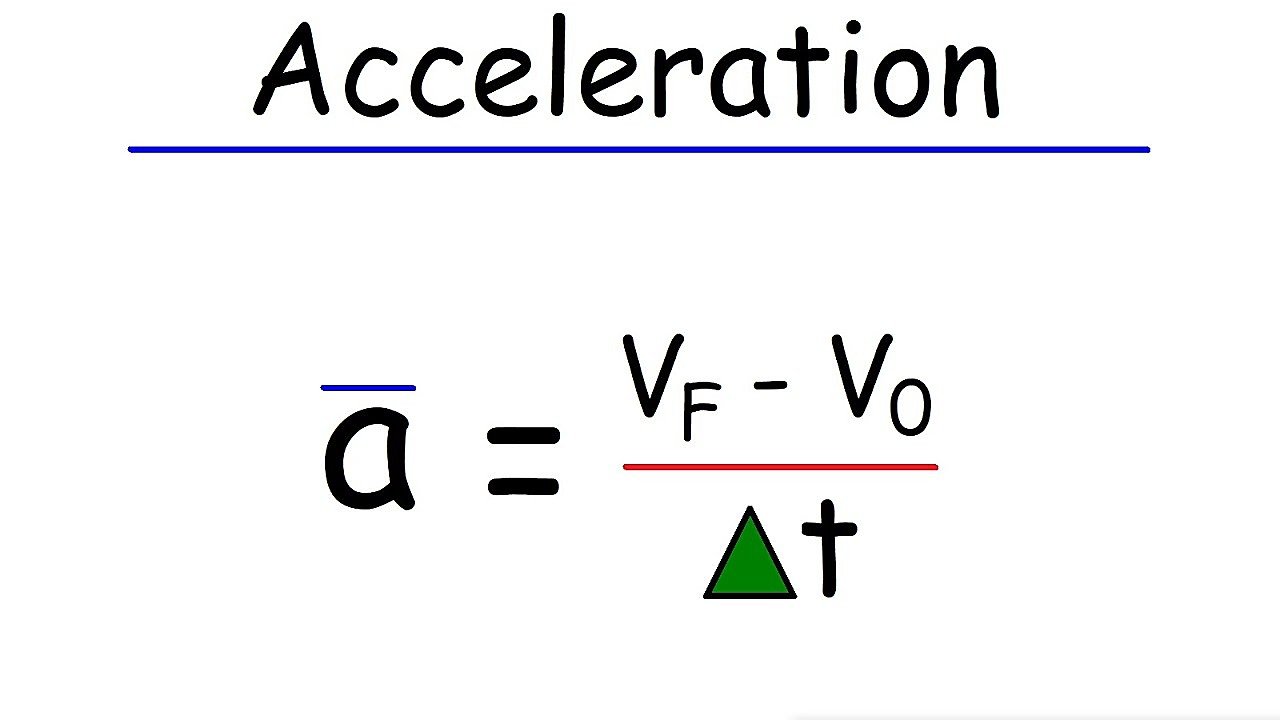
The average acceleration formula is a_avg = Δv / Δt, the change in velocity divided by the elapsed time. The result is expressed in meters per second squared (m/s²). The 6 methods use velocity and time, a graph, a data table, calculus, force and mass, or distance and time.
For a reliable reference, consult OpenStax section on acceleration.
What Is Average Acceleration and What Are Examples of It?
Average acceleration is the change in velocity of an object divided by the time interval in which the change occurs. OpenStax University Physics Volume 1 writes the formula as a_avg = Δv / Δt = (v_f − v_0) / (t_f − t_0).
Average acceleration is a vector quantity, so it has a magnitude and a direction. The direction matches the direction of the velocity change. The SI unit is meters per second squared (m/s²).
The table below defines each symbol in the formula and lists its SI unit.
| Symbol | Meaning | SI Unit |
|---|---|---|
| a_avg | Average acceleration | m/s² |
| Δv | Change in velocity (v_f − v_0) | m/s |
| Δt | Elapsed time (t_f − t_0) | s |
| v_f | Final velocity | m/s |
| v_0 | Initial velocity | m/s |
| t_f | Final time | s |
| t_0 | Initial time | s |
Moving objects have an average acceleration over any time interval. Examples include cars, trains, sprinters, elevators, and falling balls.
What Are the Different Forms of the Average Acceleration Formula?
The average acceleration formula has 5 forms: symbolic, expanded, zero-start-time, vector, and component. The table below lists each form, its equation, and the condition for its use.
| Form | Equation | Use When |
|---|---|---|
| Symbolic | a_avg = Δv / Δt | Change in velocity and elapsed time are known |
| Expanded | a_avg = (v_f − v_0) / (t_f − t_0) | 2 velocities and 2 clock times are known |
| Zero start time | a_avg = (v − v_0) / t | The clock starts at t = 0 |
| Vector | a_avg = Δv⃗ / Δt | Motion occurs in 2 or 3 dimensions |
| Component | a_x = Δv_x / Δt, a_y = Δv_y / Δt | Each axis is analyzed separately |
The formula rearranges to solve for other quantities:
- Find the velocity change with Δv = a_avg × Δt.
- Find the elapsed time with Δt = Δv / a_avg.
- Find the final velocity with v_f = v_0 + a_avg × Δt.
What Are the 6 Methods to Find Average Acceleration?
The 6 methods find average acceleration from velocity and time, a velocity-time graph, a data table, a velocity function, force and mass, or distance and time. The table below lists the known quantities, formula, and condition for each method.
Symbols in the table: v_0 is initial velocity (m/s), v_f is final velocity (m/s), t is time (s), F_avg is average net force (N), m is mass (kg), and d is displacement (m). All results are in m/s².
| Method | Known Quantities | Formula | Applies When |
|---|---|---|---|
| Velocity and time | v_0, v_f, t_0, t_f | a_avg = (v_f − v_0) / (t_f − t_0) | Velocity is known at 2 moments |
| Velocity-time graph | 2 points on the graph | a_avg = rise / run between the points | A velocity-time graph is available |
| Data table | Pairs of velocity and time | a_avg = Δv / Δt for each interval | Measurements are listed in a table |
| Calculus | Velocity function v(t) | a_avg = (v(t₂) − v(t₁)) / (t₂ − t₁) | Velocity is given as an equation |
| Force and mass | F_avg, m | a_avg = F_avg / m | Mass is constant and net force is known |
| Distance and time | d, t, v_0 | a_avg = 2(d − v_0 t) / t² | Acceleration is constant |
How Do You Find Average Acceleration From Velocity and Time?
Average acceleration is found by subtracting the initial velocity from the final velocity and dividing by the elapsed time.
- Identify the initial velocity (v_0) and the final velocity (v_f).
- Subtract the initial velocity from the final velocity.
- Identify the elapsed time (t_f − t_0).
- Divide the velocity change by the elapsed time.
Example: A train speeds up from 5 m/s to 25 m/s in 8 s. The average acceleration is (25 − 5) / 8 = 2.5 m/s².
How Do You Find Average Acceleration From a Velocity-Time Graph?
Average acceleration is found by dividing the rise by the run between 2 points on a velocity-time graph. The value equals the slope of the straight line that joins the 2 points.
Example: A graph shows 6 m/s at 2 s and 30 m/s at 8 s. The average acceleration is (30 − 6) / (8 − 2) = 4 m/s².
A curved graph has a different slope at each point. The slope of the line joining 2 points gives the average acceleration. The slope of the tangent line at 1 point gives the instantaneous acceleration.
Research by Lillian McDermott, Mark Rosenquist, and Emily van Zee, published in the American Journal of Physics in 1987, found that students confuse the height of a graph with its slope.
How Do You Find Average Acceleration From a Table of Data?
Average acceleration is found by dividing the velocity change by the time change between 2 rows of the table. The table below lists a cart's velocity at 4 times and the average acceleration for each interval. The last row gives the full interval.
| Interval (s) | Initial Velocity (m/s) | Final Velocity (m/s) | Δt (s) | a_avg (m/s²) |
|---|---|---|---|---|
| 0 to 2 | 0 | 8 | 2 | 4 |
| 2 to 4 | 8 | 16 | 2 | 4 |
| 4 to 6 | 16 | 18 | 2 | 1 |
| 0 to 6 | 0 | 18 | 6 | 3 |
The 3 shorter intervals have equal lengths, so their mean (4 + 4 + 1) / 3 equals 3 m/s², the same as the full interval. Intervals of unequal length require weighting each value by its duration.
How Do You Find Average Acceleration From a Velocity Function Using Calculus?
Average acceleration is found by evaluating the velocity function at 2 times and dividing the difference by the time interval. The integral form is a_avg = (1 / (t₂ − t₁)) ∫ a(t) dt, taken from t₁ to t₂. By the fundamental theorem of calculus, this equals Δv / Δt.
Example: A velocity function is v(t) = t² + 2t, in m/s. Velocity is 3 m/s at 1 s and 15 m/s at 3 s. The average acceleration is (15 − 3) / (3 − 1) = 6 m/s².
The instantaneous acceleration is a(t) = 2t + 2. It equals 4 m/s² at 1 s and 8 m/s² at 3 s. The integral check gives (1 / 2) × [t² + 2t] from 1 to 3 = (1 / 2) × 12 = 6 m/s².
A position function x(t) requires 2 derivatives to reach a(t). The first derivative gives velocity, and the second gives acceleration.
How Do You Find Average Acceleration From Net Force and Mass?
Average acceleration is found by dividing the average net force by the mass (a_avg = F_avg / m), if the mass is constant. According to NASA Glenn Research Center, net force equals mass times acceleration for an object with constant mass.
The impulse-momentum theorem gives the same result. The equation F_avg × Δt = m × Δv rearranges to a_avg = F_avg / m.
Example: A 1,000 kg car has an average net force of 3,500 N. The average acceleration is 3,500 / 1,000 = 3.5 m/s².
Net force is the vector sum of all forces. Subtract friction from the applied force to find the net force, if friction acts on the object.
How Do You Find Average Acceleration From Distance and Time?
Average acceleration is found with a_avg = 2(d − v_0 t) / t², if the acceleration is constant. The formula becomes a_avg = 2d / t², if the object starts from rest.
Example: An object starts at 4 m/s and covers 60 m in 5 s. The acceleration is 2 × (60 − 4 × 5) / 5² = 80 / 25 = 3.2 m/s².
Time is not required in the formula a_avg = (v_f² − v_0²) / 2d, which also applies to constant acceleration. Example: An object speeds up from 4 m/s to 14 m/s over 45 m. The acceleration is (196 − 16) / 90 = 2 m/s².
How Do You Find Average Acceleration When the Direction of Motion Changes?
Average acceleration is found by subtracting the initial velocity vector from the final velocity vector and dividing by the elapsed time. Directions receive signs in 1 dimension, and components are used in 2 dimensions.
Example in 1 dimension: A ball moves at 8 m/s toward a wall, which is the positive direction. The ball leaves at 6 m/s away from the wall. The contact lasts 0.02 s. The velocity change is −6 − 8 = −14 m/s. The average acceleration is −14 / 0.02 = −700 m/s².
Example in 2 dimensions: The initial velocity is (2, 1) m/s and the final velocity is (8, 9) m/s over 2 s.
- Subtract the components: Δv = (8 − 2, 9 − 1) = (6, 8) m/s.
- Divide each component by 2 s: a_avg = (3, 4) m/s².
- Find the magnitude: √(3² + 4²) = 5 m/s².
- Find the direction: arctan(4 / 3) ≈ 53.1° above the positive x-axis.
What Does the Sign of Average Acceleration Mean?
The sign of average acceleration shows the direction of the velocity change along the chosen axis. An object speeds up if velocity and acceleration share a sign. An object slows down if they have opposite signs.
The table below lists the 4 combinations of velocity sign and acceleration sign, with the resulting motion and an example. The upward direction is positive.
| Velocity Sign | Average Acceleration Sign | Result | Example |
|---|---|---|---|
| Positive | Positive | Speeds up | A rocket gaining upward speed |
| Positive | Negative | Slows down | A ball rising after release |
| Negative | Negative | Speeds up | A stone falling after release |
| Negative | Positive | Slows down | A parachutist after the parachute opens |
Deceleration is the term for acceleration directed opposite to velocity. Negative acceleration does not always mean slowing down.
What Is the Difference Between Average Acceleration and Instantaneous Acceleration?
Average acceleration describes the velocity change over a time interval, and instantaneous acceleration describes the acceleration at a single moment. The table below compares the 2 types by 5 features.
| Feature | Average Acceleration | Instantaneous Acceleration |
|---|---|---|
| Definition | Change in velocity over an interval | Acceleration at one instant |
| Formula | a_avg = Δv / Δt | a = dv/dt, the limit of Δv / Δt as Δt approaches 0 |
| Line on a velocity-time graph | Secant line joining 2 points | Tangent line at 1 point |
| Value for constant acceleration | Equals the constant | Equals the constant |
| Example with v(t) = t² + 2t | 6 m/s² from 1 s to 3 s | 4 m/s² at 1 s |
Average acceleration equals instantaneous acceleration at every moment, if the acceleration is constant. Average acceleration equals the mean of the 2 end-point accelerations, if the acceleration changes linearly with time.
What Is the Difference Between Average Acceleration, Average Velocity, and Average Speed?
Average acceleration measures the rate of change of velocity, average velocity measures the rate of change of position, and average speed measures distance per unit time. The table below compares the 3 quantities by formula, type, and unit. The example column uses a runner on a straight track.
| Quantity | Formula | Type | SI Unit | Example |
|---|---|---|---|---|
| Average speed | Total distance / Δt | Scalar | m/s | 100 m in 20 s gives 5 m/s |
| Average velocity | Displacement / Δt | Vector | m/s | 100 m east in 20 s gives 5 m/s east |
| Average acceleration | Δv / Δt | Vector | m/s² | Velocity rises from 0 to 5 m/s in 2 s, giving 2.5 m/s² |
Average velocity equals (v_0 + v_f) / 2 for constant acceleration.
How Do You Find Average Acceleration in Circular Motion?
Average acceleration in circular motion is found with a_avg = Δv / Δt, using the change in the velocity vector between 2 positions. The velocity vector changes direction at every point on a circle, even at constant speed.
A full revolution returns the velocity vector to its starting value. The change Δv equals 0, so the average acceleration over 1 full revolution is 0.
A half revolution reverses the velocity vector. The change has a magnitude of 2v, and the time is πr / v. The average acceleration magnitude is 2v² / (πr).
Example: A car travels at 10 m/s around a circle with a radius of 25 m. The average acceleration over a half revolution is 2 × 10² / (π × 25) ≈ 2.55 m/s². The instantaneous centripetal acceleration is v² / r = 4 m/s².
How Do You Find Average Angular Acceleration?
Average angular acceleration is found with α_avg = Δω / Δt, where ω is angular velocity in radians per second. The unit is radians per second squared (rad/s²).
Example: A wheel speeds up from 0 to 40 rad/s in 8 s. The average angular acceleration is 40 / 8 = 5 rad/s².
Tangential acceleration equals the radius times the angular acceleration (a_t = rα). A point 0.3 m from the axis of the wheel has a tangential acceleration of 0.3 × 5 = 1.5 m/s².
What Are Examples of Average Acceleration Calculations in Real Life?
Real-life examples include cars, trains, sprinters, buses, and falling balls. The table below lists 5 situations with initial velocity, final velocity, time interval, and average acceleration. The direction of initial motion is positive, except for the falling ball, where downward is positive.
| Situation | Initial Velocity (m/s) | Final Velocity (m/s) | Time Interval (s) | Average Acceleration (m/s²) |
|---|---|---|---|---|
| Car from rest to 60 mph | 0 | 26.82 | 6.0 | 4.47 |
| Train leaving a station | 5 | 25 | 8 | 2.5 |
| Sprinter at the start | 0 | 9 | 3 | 3 |
| Bus braking | 20 | 8 | 6 | −2 |
| Ball in free fall from rest | 0 | 19.6 | 2 | 9.8 |
The conversion 60 mph × 0.44704 equals 26.82 m/s. An average acceleration of 4.47 m/s² equals 0.46 g, because 4.47 / 9.80665 ≈ 0.46.
What Are the Units of Average Acceleration and How Are They Converted?
The SI unit of average acceleration is meters per second squared (m/s²). The unit comes from dividing velocity (m/s) by time (s). The table below lists 5 units and the value of each in m/s².
| Unit Name | Symbol | Value in m/s² |
|---|---|---|
| Meter per second squared | m/s² | 1 |
| Foot per second squared | ft/s² | 0.3048 |
| Mile per hour per second | mph/s | 0.44704 |
| Kilometer per hour per second | km/h/s | 0.27778 |
| Standard gravity | g | 9.80665 |
NIST defines standard gravity as exactly 9.80665 m/s². Multiply a value by its m/s² equivalent to convert to m/s². Example: 6 mph/s × 0.44704 ≈ 2.68 m/s².
Convert velocities before calculating. Divide km/h by 3.6 to obtain m/s. Example: 72 km/h equals 20 m/s.
How Do You Measure Average Acceleration Experimentally?
Average acceleration is measured by recording velocity at 2 moments and dividing the velocity change by the elapsed time. Sensors record the velocities. Examples include photogates, motion detectors, and radar guns.
A photogate experiment follows 5 steps:
- Place 2 photogates at known positions along a track.
- Measure the length of the card on the cart.
- Divide the card length by the blocking time at each gate to find 2 velocities.
- Record the time between the 2 gates and apply a_avg = Δv / Δt.
- Repeat 3 trials and average the results to reduce random error.
Smartphone accelerometers record acceleration along 3 axes. Averaging linear-acceleration readings over an interval gives the average acceleration for that interval.
What Are the Common Mistakes When Using the Average Acceleration Formula?
6 common mistakes cause incorrect average acceleration results. Research by David Trowbridge and Lillian McDermott, published in the American Journal of Physics in 1981, found that introductory physics students commonly have difficulty distinguishing acceleration from velocity.
The mistakes include:
- Using speed instead of velocity, which removes direction.
- Dividing by the final time instead of the elapsed time.
- Mixing units, such as km/h for velocity with seconds for time.
- Dropping the sign, which hides deceleration and direction changes.
- Averaging the 2 end-point accelerations, which is valid only if acceleration changes linearly with time.
- Applying constant-acceleration formulas to motion with changing acceleration.
Example of the second mistake: Velocity changes from 10 m/s to 30 m/s between t = 4 s and t = 9 s. The elapsed time is 5 s, so a_avg = 20 / 5 = 4 m/s². Dividing by 9 s gives 2.2 m/s², which is incorrect.
What Do People Also Ask About the Average Acceleration Formula?
What is the formula for average acceleration?
The formula is a_avg = (v_f − v_0) / (t_f − t_0), which divides the change in velocity by the elapsed time.
What is the unit of average acceleration?
The SI unit of average acceleration is meters per second squared (m/s²).
Is average acceleration a vector or a scalar?
Average acceleration is a vector, and its direction matches the direction of the velocity change.
Can average acceleration be negative?
Average acceleration is negative when the velocity change points in the negative direction of the chosen axis.
Can average acceleration be zero while an object moves?
Average acceleration is zero when the final velocity equals the initial velocity, as in 1 full lap at constant speed.
How do you find average acceleration without time?
Use a = (v_f² − v_0²) / 2d, which requires initial velocity, final velocity, and displacement, if acceleration is constant.
How do you find average acceleration from a graph?
Divide the rise by the run between 2 points on the velocity-time graph.
How do you find average acceleration with force and mass?
Divide the average net force in newtons by the mass in kilograms (a_avg = F_avg / m).
When does average acceleration equal instantaneous acceleration?
Average acceleration equals instantaneous acceleration when the acceleration is constant.
What is the average acceleration formula in calculus?
The formula is a_avg = (1 / (t₂ − t₁)) ∫ a(t) dt, which equals Δv / Δt.
How do you convert average acceleration to g?
Divide the value in m/s² by 9.80665.
What is the average acceleration of a freely falling object?
A freely falling object has an average acceleration of about 9.8 m/s² near Earth's surface, if air resistance is absent.
What Is the Average Acceleration Formula and How Is It Applied?
The average acceleration formula is a_avg = Δv / Δt, which divides the change in velocity by the elapsed time. The 6 methods use velocity and time, a velocity-time graph, a data table, a velocity function, force and mass, or distance and time. The result is a vector expressed in m/s², and its sign shows the direction of the velocity change. Average acceleration equals instantaneous acceleration when acceleration is constant. Applications include cars, trains, falling objects, circular motion, and rotating wheels.
Title: Electric Force Equation: Coulomb's Law, 7 Formulas, and Examples

The University of the West Indies
My passion as a teacher and leader in education is to contribute to students’ enhanced learning by creation of a positive teaching/learning environment, where they are motivated to develop strong critical thinking, analytical and problem-solving skills.
As acting Vice-Principal and head of Physics, I have amassed five years of experience in leading meetings, implementing strategies to maintain discipline and school ethos, liaise with stakeholders in planning for future development of the institution; successfully negotiated the implementation of various projects for student development as well as supervising effective execution of such. For the past 19 years, I have incorporated discovery learning within the classroom through practical activities, problem solving and cooperative learning and have realized that students retention in Physics and Mathematics have increased significantly.
I am always cognizant that students have different learning styles, and as such teaching strategies during planning and delivery must take this crucial factor into consideration and be tailored to meet such differences.