

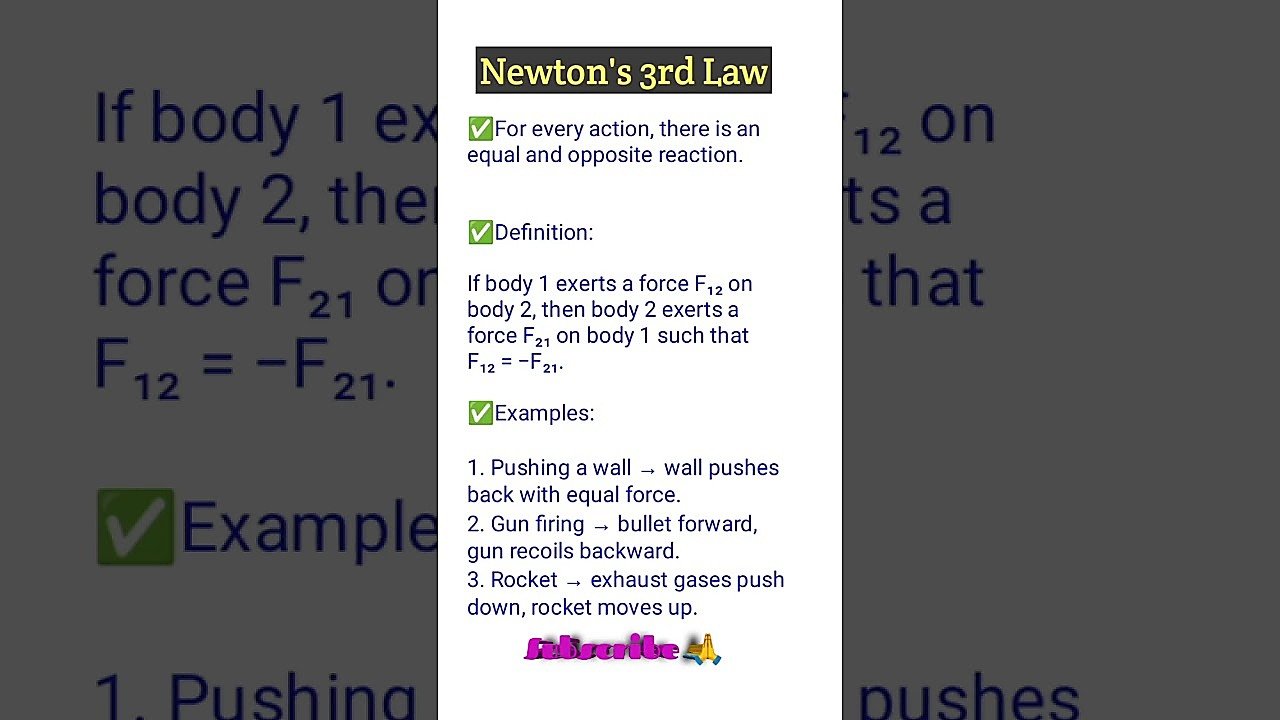
Newton's Third Law of Motion Examples: Definition, 20 Examples, and Force Pairs
Newton's third law of motion states that when object A exerts a force on object B, object B exerts a force of equal magnitude and opposite direction on object A. The formula is F_AB = −F_BA. Examples include walking, swimming, rocket launches, and rifle recoil. The 20 examples below cover daily activities, sports, vehicles, animals, and space.
For a reliable reference, consult OpenStax section on forces and Newton’s laws.
What Is Newton's Third Law of Motion and What Are Examples of It?
Newton's third law of motion is the law that forces occur in pairs, with equal magnitude and opposite direction, on 2 different objects. Isaac Newton published the law in the Principia in 1687. Other names include the action-reaction law and the law of reciprocal actions.
According to OpenStax University Physics Volume 1, a body that exerts a force on a second body experiences an equal and opposite force from that second body. The 2 forces form an action-reaction pair, also called an interaction pair or force pair.
Examples include a foot pushing the ground, a swimmer pushing water, and a rocket pushing exhaust gas. The 2 forces in each example act on different objects.
The table below lists 6 properties of a force pair. The last column applies each property to a hand that pushes a wall with 50 N.
| Property | Meaning for a Force Pair | Example: Hand Pushing a Wall With 50 N |
|---|---|---|
| Magnitude | Equal | Hand on wall is 50 N, and wall on hand is 50 N |
| Direction | Opposite | Hand pushes toward the wall, and wall pushes toward the hand |
| Type of force | Same | Both forces are contact forces |
| Timing | Simultaneous | Both forces start and end together |
| Objects | 2 different objects | One force acts on the wall, and the other acts on the hand |
| Line of action | Same straight line | Both forces act along the pushing direction |
What Is the Formula for Newton's Third Law of Motion?
The formula is F_AB = −F_BA, where F_AB is the force of object A on object B and F_BA is the force of object B on object A. The negative sign shows opposite directions. The table below defines each symbol.
| Symbol | Meaning | SI Unit |
|---|---|---|
| F_AB | Force of object A on object B | newton (N) |
| F_BA | Force of object B on object A | newton (N) |
| m_A, m_B | Mass of object A and object B | kilogram (kg) |
| a_A, a_B | Acceleration of object A and object B | m/s² |
3 forms of the law are used in calculations:
- Vector form: F_AB = −F_BA
- Magnitude form: |F_AB| = |F_BA|
- Acceleration form: a_A / a_B = m_B / m_A, for magnitudes
The acceleration form follows from Newton's second law (F = ma) applied to each object. The object with the smaller mass has the larger acceleration.
What Are 20 Examples of Newton's Third Law of Motion?
The 20 examples fall into 5 categories: daily activities, sports, vehicles and devices, animals, and space and fields. Each table lists the action, the reaction, and the visible result.
What Are Examples of Newton's Third Law in Daily Activities?
Daily activities that show the law include walking, jumping, pushing a wall, sitting on a chair, and releasing a balloon. The table below lists 5 examples with the force of object A on object B and the equal and opposite force of object B on object A.
| No. | Example | Action (Force of A on B) | Reaction (Force of B on A) | Visible Result |
|---|---|---|---|---|
| 1 | Walking | Foot pushes the ground backward | Ground pushes the foot forward | Body moves forward |
| 2 | Jumping | Legs push the ground downward | Ground pushes the body upward | Body leaves the ground |
| 3 | Pushing a wall | Hand pushes the wall | Wall pushes the hand | Hand feels the push |
| 4 | Sitting on a chair | Body pushes the seat downward | Seat pushes the body upward | Body stays supported |
| 5 | Releasing a balloon | Balloon pushes air backward through the nozzle | Air pushes the balloon forward | Balloon moves forward |
Example: A 70 kg person weighs 70 × 9.8 = 686 N. A push of 1,400 N on the ground gives a net upward force of 1,400 − 686 = 714 N on the body. The acceleration is 714 / 70 = 10.2 m/s².
What Are Examples of Newton's Third Law in Sports?
Sports that show the law include swimming, rowing, kicking a soccer ball, and skating. The table below lists 4 examples with the action, the reaction, and the visible result.
| No. | Example | Action (Force of A on B) | Reaction (Force of B on A) | Visible Result |
|---|---|---|---|---|
| 6 | Swimming | Hands and feet push water backward | Water pushes the swimmer forward | Swimmer moves forward |
| 7 | Rowing | Oar blades push water backward | Water pushes the oars and boat forward | Boat moves forward |
| 8 | Kicking a soccer ball | Foot pushes the ball forward | Ball pushes the foot backward | Ball accelerates, and the foot feels the impact |
| 9 | Ice skaters pushing apart | Skater A pushes skater B | Skater B pushes skater A | Skaters move in opposite directions |
Example: A foot kicks a 0.43 kg soccer ball to 25 m/s with a contact time of 0.01 s. The average force is 0.43 × 25 / 0.01 = 1,075 N. The ball pushes the foot with 1,075 N in the opposite direction.
What Are Examples of Newton's Third Law in Vehicles and Devices?
Vehicles and devices that show the law include cars, jet engines, helicopters, and rifles. The table below lists 4 examples with the action, the reaction, and the visible result.
| No. | Example | Action (Force of A on B) | Reaction (Force of B on A) | Visible Result |
|---|---|---|---|---|
| 10 | Car tires | Tires push the road backward | Road pushes the tires forward through friction | Car accelerates |
| 11 | Jet engine | Engine pushes hot gas backward | Gas pushes the engine forward | Aircraft moves forward |
| 12 | Helicopter | Rotor blades push air downward | Air pushes the blades upward | Helicopter lifts or hovers |
| 13 | Rifle recoil | Rifle pushes the bullet forward | Bullet pushes the rifle backward | Rifle recoils against the shoulder |
Example: A 1,500 kg helicopter in hover has a weight of 14,700 N. The rotor pushes air downward with 14,700 N, and the air pushes the rotor upward with 14,700 N.
What Are Examples of Newton's Third Law in Animals?
Animals that show the law include birds, squids, and fish. The table below lists 3 examples with the action, the reaction, and the visible result.
| No. | Example | Action (Force of A on B) | Reaction (Force of B on A) | Visible Result |
|---|---|---|---|---|
| 14 | Bird flight | Wings push air downward and backward | Air pushes the wings upward and forward | Bird gains lift and speed |
| 15 | Squid jet propulsion | Squid pushes water out of the siphon | Water pushes the squid in the opposite direction | Squid moves through the water |
| 16 | Fish swimming | Tail fin pushes water sideways and backward | Water pushes the fish forward | Fish moves forward |
Anderson and Grosenbaugh published a study of jet flow in swimming squid in the Journal of Experimental Biology in 2005. Example: A 1.0 kg bird in level flight pushes air downward with an average force of 9.8 N, and the air pushes the bird upward with 9.8 N.
What Are Examples of Newton's Third Law in Space and Fields?
Space and field examples include rockets, astronauts, gravity, and magnets. The table below lists 4 examples with the action, the reaction, and the visible result.
| No. | Example | Action (Force of A on B) | Reaction (Force of B on A) | Visible Result |
|---|---|---|---|---|
| 17 | Rocket launch | Rocket pushes exhaust gas downward | Gas pushes the rocket upward | Rocket ascends |
| 18 | Astronaut throwing a tool | Astronaut pushes the tool away | Tool pushes the astronaut in the opposite direction | Astronaut drifts backward |
| 19 | Earth and Moon | Earth pulls the Moon with gravity | Moon pulls the Earth with an equal gravitational force | Both bodies orbit a common center of mass |
| 20 | Two magnets | Magnet A attracts magnet B | Magnet B attracts magnet A | Magnets move toward each other |
Example: The gravitational force between the Earth and the Moon is about 1.98 × 10²⁰ N. The Earth pulls the Moon with 1.98 × 10²⁰ N, and the Moon pulls the Earth with 1.98 × 10²⁰ N.
How Do You Solve a Newton's Third Law Problem?
A Newton's third law problem is solved by naming the force pair and applying F = ma to each object separately. The 5 steps are:
- Identify the 2 interacting objects.
- Name the force as the force of A on B.
- Write the pair as the force of B on A, with the same magnitude and the opposite direction.
- Apply F = ma to each object, using the mass of that object.
- Compare the accelerations with a_A / a_B = m_B / m_A.
How Do You Calculate the Accelerations of Ice Skaters Pushing Apart?
Each skater receives the same force, so the skater with the smaller mass has the larger acceleration. Skater A has a mass of 60 kg, and skater B has a mass of 40 kg. Skater A pushes skater B with 100 N, and skater B pushes skater A with 100 N.
- Acceleration of skater A: 100 / 60 = 1.67 m/s²
- Acceleration of skater B: 100 / 40 = 2.5 m/s²
The ratio 2.5 / 1.67 equals 1.5, which matches the mass ratio 60 / 40.
How Do You Calculate the Forces in a Truck and Car Collision?
The truck and the car exert equal forces on each other, and the car has the larger acceleration. A truck has a mass of 8,000 kg, and a car has a mass of 1,000 kg. The collision force is 20,000 N on each vehicle.
- Acceleration of the car: 20,000 / 1,000 = 20 m/s²
- Acceleration of the truck: 20,000 / 8,000 = 2.5 m/s²
The car's acceleration is 8 times larger, which equals the mass ratio 8,000 / 1,000.
How Do You Calculate the Force Pair Between the Earth and a Falling Apple?
The Earth pulls the apple downward with a force equal to the force of the apple pulling the Earth upward. A 0.10 kg apple has a weight of 0.10 × 9.8 = 0.98 N.
- Acceleration of the apple: 0.98 / 0.10 = 9.8 m/s²
- Acceleration of the Earth: 0.98 / (5.972 × 10²⁴) ≈ 1.64 × 10⁻²⁵ m/s²
The Earth's acceleration is too small to measure because of the Earth's mass of 5.972 × 10²⁴ kg.
How Do You Calculate Rifle Recoil?
A rifle recoils with the same force that accelerates the bullet, but with a much smaller acceleration. A bullet has a mass of 0.010 kg, and a rifle has a mass of 4.0 kg. The average force in the barrel is 2,000 N.
- Acceleration of the bullet: 2,000 / 0.010 = 200,000 m/s²
- Acceleration of the rifle: 2,000 / 4.0 = 500 m/s²
The bullet reaches 400 m/s in 400 / 200,000 = 0.002 s. The rifle recoil speed is 500 × 0.002 = 1.0 m/s.
How Do You Calculate Rocket Thrust and Acceleration?
Rocket thrust is calculated by multiplying the exhaust mass flow rate by the exhaust velocity (F = ṁ × v_e). According to NASA Glenn Research Center, the full thrust equation adds a pressure term, which is small in this simplified case.
Example: A rocket expels 100 kg/s of exhaust at 2,500 m/s relative to the rocket. The rocket pushes the exhaust downward with 100 × 2,500 = 250,000 N. The exhaust pushes the rocket upward with 250,000 N.
The rocket has a mass of 20,000 kg and a weight of 196,000 N. The net force is 250,000 − 196,000 = 54,000 N. The acceleration is 54,000 / 20,000 = 2.7 m/s².
How Do You Identify Action-Reaction Pairs?
An action-reaction pair is identified by reversing the objects in the description of the force. The force of A on B has the partner force of B on A.
The 4 checks confirm a pair:
- Check the force type: both forces have the same type, such as gravity or contact force.
- Check the magnitude: both forces have equal size.
- Check the direction: the 2 forces point in opposite directions.
- Check the objects: the 2 forces act on different objects.
Pairs follow the form "force of X on Y" and "force of Y on X". Example: The force of a tire on the road pairs with the force of the road on the tire.
Why Do Action and Reaction Forces Not Cancel Each Other?
Action and reaction forces do not cancel because they act on different objects. The net force on an object includes only the forces that act on that object.
Example: A person pushes a 20 kg box with 100 N, and friction on the box is 40 N.
- The net force on the box is 100 − 40 = 60 N.
- The acceleration of the box is 60 / 20 = 3 m/s².
- The reaction force of 100 N acts on the person, in the backward direction.
- The reaction to the friction force is the force of the box on the floor, with a magnitude of 40 N.
Are Weight and Normal Force a Newton's Third Law Pair?
Weight and normal force are not a Newton's third law pair, because both forces act on the same object. The partner of weight is the gravitational pull of the object on the Earth. The partner of the normal force is the push of the object on the surface.
The table below lists the 4 forces in a system of a 1.0 kg book on a table. Each row gives the force, the object that exerts it, the object that receives it, and the partner force.
| Force | Exerted By | Acts On | Magnitude | Direction | Third-Law Partner |
|---|---|---|---|---|---|
| Weight (gravity) | Earth | Book | 9.8 N | Down | Gravity on the Earth by the book |
| Normal force | Table | Book | 9.8 N | Up | Push on the table by the book |
| Gravity on the Earth | Book | Earth | 9.8 N | Up | Weight of the book |
| Push on the table | Book | Table | 9.8 N | Down | Normal force |
Weight and normal force are equal because the book has zero acceleration, as Newton's first law states. A book in an upward-accelerating elevator has a normal force larger than its weight, and the 2 forces still do not form a pair.
What Is the Difference Between Newton's 3 Laws of Motion?
Newton's 3 laws describe inertia, acceleration, and force pairs. The table below compares the 3 laws by statement, formula, and example.
| Law | Statement | Formula | Example |
|---|---|---|---|
| First law | An object keeps its state of motion if the net force is zero | ΣF = 0 gives a = 0 | A hockey puck slides at constant velocity on frictionless ice |
| Second law | Acceleration equals net force divided by mass | a = F / m | A 1,000 kg car with a 3,500 N net force accelerates at 3.5 m/s² |
| Third law | Forces between 2 objects form equal and opposite pairs | F_AB = −F_BA | A swimmer pushes water backward, and water pushes the swimmer forward |
How Does Newton's Third Law Relate to Conservation of Momentum?
Newton's third law leads to conservation of momentum, because equal and opposite forces acting for the same time produce equal and opposite impulses. The total momentum of an isolated 2-object system stays constant: m_A v_A + m_B v_B = constant.
Example: An astronaut with a mass of 80 kg floats at rest and throws a 2 kg tool at 3 m/s. The total momentum stays 0, so 80 × v + 2 × 3 = 0. The astronaut recoils at v = −0.075 m/s, which is 0.075 m/s in the direction opposite to the tool.
Does Newton's Third Law Work in Space and Without Contact?
Newton's third law works in a vacuum and applies to gravitational, electric, and magnetic forces without contact. According to NASA Glenn Research Center, rockets produce thrust through the same action-reaction principle. A rocket needs no air to push against, because the exhaust gas pushes the rocket.
Electric forces follow the law. Two charges of +3 μC and +5 μC at 0.20 m apart exert 3.37 N on each other, with the 2 forces in opposite directions. Gravity also follows the law, as the Earth and Moon example shows.
When Does Newton's Third Law Not Apply Directly?
Newton's third law in its simple form does not apply to fictitious forces and to magnetic interactions between moving charges. The 3 cases are:
- Fictitious forces: Centrifugal and Coriolis forces appear in rotating reference frames and have no reaction partner.
- Moving charges: The electromagnetic field carries momentum, so the forces between 2 moving charges are not always equal and opposite at the same instant.
- Delayed interactions: Fields travel at the speed of light, so distant interactions show a delay between the 2 forces.
Total momentum, including the momentum of the field, is conserved in all 3 cases.
What Are the Common Mistakes and Misconceptions About Newton's Third Law?
6 common misconceptions cause errors in force-pair problems. Hestenes, Wells, and Swackhamer introduced the Force Concept Inventory in The Physics Teacher in 1992. The inventory includes collision questions between heavy and light objects, and many students choose answers that give the heavier object the larger force. Halloun and Hestenes published a study in the American Journal of Physics in 1985 and found that many students hold common sense beliefs about force that conflict with Newtonian mechanics.
The misconceptions include:
- Believing the larger object exerts the larger force.
- Believing action and reaction forces cancel each other.
- Believing weight and the normal force form a pair.
- Believing the reaction force occurs after the action force.
- Believing equal forces cause equal accelerations.
- Believing the reaction force requires air or contact.
Example of the fifth misconception: Equal forces of 20,000 N give the car 20 m/s² and the truck 2.5 m/s², because the masses differ.
What Are the Real-World Applications of Newton's Third Law?
Newton's third law applies to 6 technologies and fields. Applications include:
- Rocket engines and spacecraft thrusters, which expel mass to produce thrust.
- Jet engines and propellers, which push air or water backward.
- Helicopter rotors, which push air downward to produce lift.
- Force plates, which measure the ground reaction force in biomechanics and sports science.
- Artillery and firearm recoil systems, which absorb the backward force.
- Walking robots and prosthetics, which use ground reaction forces for balance and propulsion.
Cavanagh and Lafortune published a study of ground reaction forces in distance running in the Journal of Biomechanics in 1980. Peak vertical forces reached roughly 2 to 3 times body weight.
How Do You Demonstrate Newton's Third Law Experimentally?
Newton's third law is demonstrated by hooking 2 spring scales together and comparing their readings while 1 scale pulls the other. Both scales show the same value at every force, within instrument error. The 5 steps are:
- Hook the 2 spring scales together.
- Hold the first scale fixed.
- Pull the second scale horizontally.
- Record both readings.
- Repeat the measurement at 3 different forces.
Example: A pull of 4.0 N gives a reading of 4.0 N on both scales. A balloon rocket on a straight string shows the same law, because the air pushed backward moves the balloon forward.
What Do People Also Ask About Newton's Third Law of Motion Examples?
What is Newton's third law of motion in simple terms?
Every force between 2 objects is part of a pair of equal and opposite forces that act on the 2 objects.
What is the formula for Newton's third law?
The formula is F_AB = −F_BA.
What are 5 examples of Newton's third law?
Examples include walking, swimming, jumping, rocket launches, and rifle recoil.
What is an example of Newton's third law in sports?
A swimmer pushes water backward, and the water pushes the swimmer forward.
What is an example of Newton's third law in space?
An astronaut throws a tool in 1 direction and drifts in the opposite direction.
Do action and reaction forces cancel each other?
Action and reaction forces do not cancel, because they act on different objects.
Are action and reaction forces always equal?
Action and reaction forces have equal magnitude in every force pair.
Which force is the action and which is the reaction?
Either force can be called the action, because the 2 labels are interchangeable.
Does the reaction force occur after the action force?
The 2 forces occur at the same time.
Why does the Earth not move when a person jumps?
The Earth accelerates by only about 2.3 × 10⁻²² m/s² under a 1,400 N push, because its mass is 5.972 × 10²⁴ kg.
Does Newton's third law work in a vacuum?
Newton's third law works in a vacuum, as rocket propulsion in space shows.
Who discovered Newton's third law?
Isaac Newton published the law in the Principia in 1687.
How does Newton's third law relate to conservation of momentum?
The third law implies that the total momentum of an isolated system stays constant.
What Are Newton's Third Law of Motion Examples and How Do They Work?
Newton's third law of motion examples show forces in equal and opposite pairs, written as F_AB = −F_BA. The 20 examples cover walking, jumping, swimming, rowing, car tires, jet engines, helicopters, rifle recoil, bird flight, squid propulsion, rocket launches, and gravity. The 2 forces in a pair act on different objects, so they do not cancel. Equal forces give different accelerations if the masses differ, as the 60 kg and 40 kg skaters show. Weight and the normal force are not a pair. The law leads to conservation of momentum and applies in a vacuum and to gravitational, electric, and magnetic forces.
Title: Buoyant Force Equation: Formula, 7 Forms, and Worked Examples

The University of the West Indies
My passion as a teacher and leader in education is to contribute to students’ enhanced learning by creation of a positive teaching/learning environment, where they are motivated to develop strong critical thinking, analytical and problem-solving skills.
As acting Vice-Principal and head of Physics, I have amassed five years of experience in leading meetings, implementing strategies to maintain discipline and school ethos, liaise with stakeholders in planning for future development of the institution; successfully negotiated the implementation of various projects for student development as well as supervising effective execution of such. For the past 19 years, I have incorporated discovery learning within the classroom through practical activities, problem solving and cooperative learning and have realized that students retention in Physics and Mathematics have increased significantly.
I am always cognizant that students have different learning styles, and as such teaching strategies during planning and delivery must take this crucial factor into consideration and be tailored to meet such differences.