

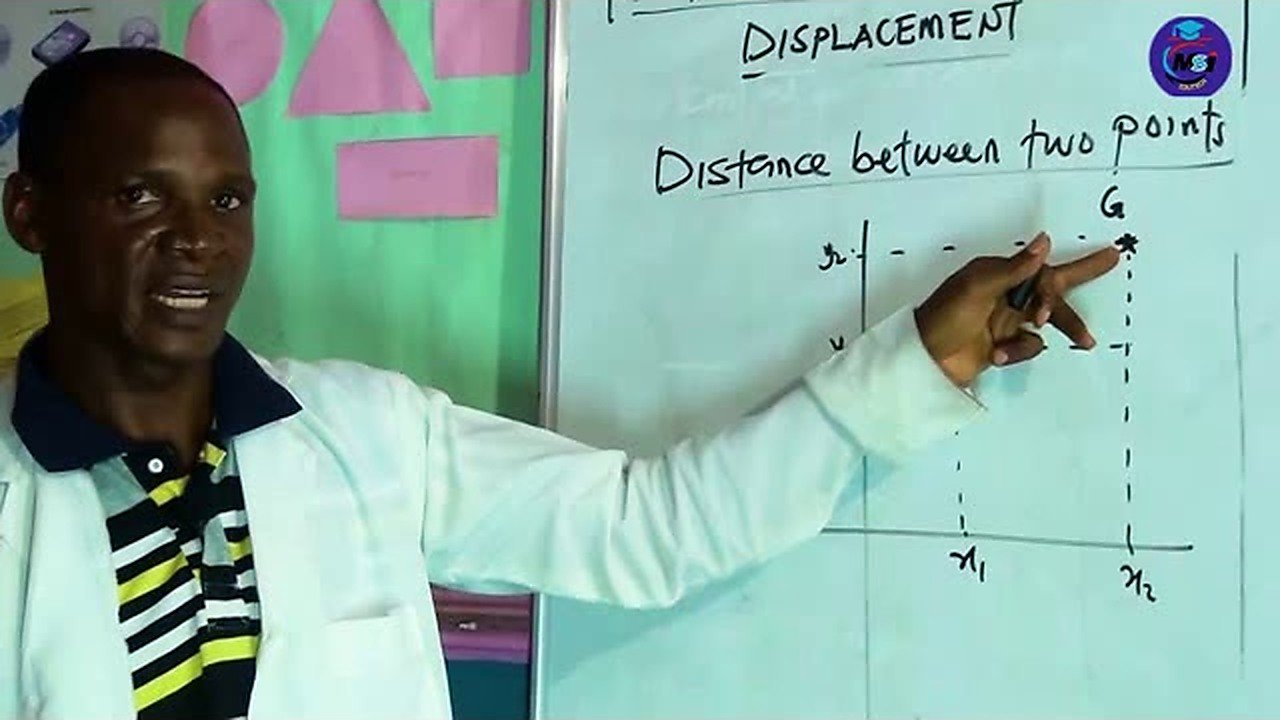
How to Determine Displacement: 7 Methods, Formulas, and Examples
Displacement is determined by subtracting the initial position from the final position (Δx = x_f − x_i). The result has a magnitude and a direction, and it is expressed in meters (m). The 7 methods use positions, coordinates, average velocity, a velocity-time graph, constant acceleration equations, calculus, or vector addition.
For a reliable reference, consult OpenStax section on position and displacement.
What Is Displacement and What Are Examples of Displacement?
Displacement is the change in position of an object, measured as a straight-line vector from the start point to the end point. According to OpenStax University Physics Volume 1, displacement is a vector quantity, so it has a magnitude and a direction. The SI unit is the meter (m).
Displacement depends only on the start point and the end point. The path between the 2 points does not change it.
Examples include a car that moves 40 m east, a runner who finishes a lap at the starting line (0 m), and a ball that falls 5 m downward.
The table below defines each symbol used in displacement formulas and lists its SI unit.
| Symbol | Meaning | SI Unit |
|---|---|---|
| Δx | Displacement along 1 axis | meter (m) |
| Δr⃗ | Displacement vector in 2 or 3 dimensions | meter (m) |
| x_i | Initial position | meter (m) |
| x_f | Final position | meter (m) |
| v_avg | Average velocity | m/s |
| v₀ | Initial velocity | m/s |
| v | Final velocity | m/s |
| a | Constant acceleration | m/s² |
| t | Elapsed time | second (s) |
What Are the 7 Methods to Determine Displacement?
The 7 methods use positions, coordinates, average velocity and time, a velocity-time graph, constant acceleration equations, calculus, or vector addition. The table below lists the known quantities, formula, and condition for each method.
| No. | Method | Known Quantities | Formula | Applies When |
|---|---|---|---|---|
| 1 | Positions | x_i, x_f | Δx = x_f − x_i | Start and end positions are known |
| 2 | Coordinates | (x₁, y₁) and (x₂, y₂) | Δr = √((x₂ − x₁)² + (y₂ − y₁)²) | Motion occurs in 2 or 3 dimensions |
| 3 | Average velocity and time | v_avg, t | Δx = v_avg × t | Average velocity is known |
| 4 | Velocity-time graph | Graph of v against t | Δx = area under the curve | A velocity-time graph is available |
| 5 | Constant acceleration | v₀, a, t | Δx = v₀t + ½at² | Acceleration is constant |
| 6 | Calculus | v(t) or a(t) | Δx = ∫ v(t) dt | Velocity or acceleration is a function of time |
| 7 | Vector addition | Several movement legs | Δr⃗ = Δr⃗₁ + Δr⃗₂ + … | Motion has several segments |
How Do You Determine Displacement From Initial and Final Position?
Displacement is determined by subtracting the initial position from the final position (Δx = x_f − x_i). The order of subtraction matters, because the reverse order flips the sign.
- Choose an axis and a positive direction.
- Identify the initial position (x_i).
- Identify the final position (x_f).
- Subtract the initial position from the final position.
- Attach the unit and the direction.
Example: An object moves from x = 3 m to x = 11 m. The displacement is 11 − 3 = +8 m. The return from 11 m to 3 m gives 3 − 11 = −8 m.
A position-time graph gives the same result. The graph shows 5 m at 2 s and 17 m at 6 s. The displacement is 17 − 5 = 12 m, and the average velocity is 12 / 4 = 3 m/s.
How Do You Determine Displacement From Coordinates in 2 or 3 Dimensions?
Displacement in 2 dimensions is determined by subtracting the start coordinates from the end coordinates and finding the magnitude with the Pythagorean theorem. The formula is Δr = √(Δx² + Δy²). The direction angle is θ = arctan(Δy / Δx).
- Subtract the coordinates: Δx = x₂ − x₁ and Δy = y₂ − y₁.
- Square each difference and add the squares.
- Take the square root to find the magnitude.
- Calculate the angle from the positive x-axis.
Example: An object moves from (2 m, 1 m) to (8 m, 9 m). The components are Δx = 6 m and Δy = 8 m. The magnitude is √(36 + 64) = 10 m. The direction is arctan(8 / 6) ≈ 53.1° above the positive x-axis.
A third dimension adds a term: Δr = √(Δx² + Δy² + Δz²).
How Do You Determine Displacement From Average Velocity and Time?
Displacement is determined by multiplying the average velocity by the elapsed time (Δx = v_avg × t). The formula comes from the definition v_avg = Δx / Δt.
Example: A cyclist keeps an average velocity of 12 m/s east for 5 s. The displacement is 12 × 5 = 60 m east.
The average velocity of motion with constant acceleration is v_avg = (v₀ + v) / 2. Example: A car speeds up from 10 m/s to 20 m/s in 5 s. The average velocity is 15 m/s, and the displacement is 15 × 5 = 75 m.
The Oxford Calculators at Merton College stated the mean speed theorem in the 1330s. The theorem states that uniformly accelerated motion covers the same distance as constant motion at the average speed.
How Do You Determine Displacement From a Velocity-Time Graph?
Displacement is determined by calculating the area between the velocity-time line and the time axis. Area above the axis is positive displacement, and area below the axis is negative displacement.
The table below lists the area formula for 3 common shapes.
| Shape on Graph | Motion Type | Area Formula |
|---|---|---|
| Rectangle | Constant velocity | Δx = v × t |
| Triangle | Acceleration from rest, or deceleration to rest | Δx = ½ × t × v |
| Trapezoid | Constant acceleration between 2 nonzero velocities | Δx = ½ × (v₁ + v₂) × t |
Example: A graph shows a rise from 0 to 20 m/s in 4 s, a constant 20 m/s for 6 s, and a fall to 0 m/s in 4 s. The table below lists the area of each segment.
| Segment | Time Interval (s) | Shape | Calculation | Displacement (m) |
|---|---|---|---|---|
| 1 | 0 to 4 | Triangle | ½ × 4 × 20 | 40 |
| 2 | 4 to 10 | Rectangle | 6 × 20 | 120 |
| 3 | 10 to 14 | Triangle | ½ × 4 × 20 | 40 |
| Total | 0 to 14 | Trapezoid | ½ × (14 + 6) × 20 | 200 |
Example with a negative area: Velocity is +4 m/s for 5 s and −2 m/s for the next 5 s. The displacement is 4 × 5 + (−2 × 5) = 20 − 10 = +10 m. The distance is 20 + 10 = 30 m.
Beichner published a study of kinematics graph interpretation in the American Journal of Physics in 1994. The study found that students have difficulty interpreting the area under a velocity-time graph as displacement.
How Do You Determine Displacement From Acceleration?
Displacement is determined from acceleration with the constant acceleration equations, which link displacement to velocity, acceleration, and time. The equations apply when acceleration is constant. Galileo Galilei showed in Two New Sciences in 1638 that distance from rest grows with the square of time.
The table below lists 4 equations. The second column names the variable that each equation does not need.
| Equation | Variable Not Needed | Use When |
|---|---|---|
| Δx = v₀t + ½at² | Final velocity (v) | v₀, a, and t are known |
| Δx = vt − ½at² | Initial velocity (v₀) | v, a, and t are known |
| Δx = ½(v₀ + v)t | Acceleration (a) | v₀, v, and t are known |
| Δx = (v² − v₀²) / (2a) | Time (t) | v₀, v, and a are known |
Example with time: A car with v₀ = 10 m/s and a = 2 m/s² accelerates for 5 s. The displacement is 10 × 5 + ½ × 2 × 5² = 50 + 25 = 75 m.
Example without time: A scooter speeds up from 5 m/s to 25 m/s with a = 3 m/s². The displacement is (25² − 5²) / (2 × 3) = 600 / 6 = 100 m.
Example with braking: A car at 20 m/s decelerates at −4 m/s² until it stops. The displacement is (0 − 20²) / (2 × −4) = 50 m. The braking time is 5 s.
The free-fall displacement from rest is Δx = ½gt², where g = 9.8 m/s². The table below lists 4 times and the displacement downward.
| Time (s) | Displacement Downward (m) |
|---|---|
| 1 | 4.9 |
| 2 | 19.6 |
| 3 | 44.1 |
| 4 | 78.4 |
How Do You Determine Displacement With Calculus?
Displacement is determined by integrating the velocity function over the time interval (Δx = ∫ v(t) dt, from t₁ to t₂). An acceleration function requires 2 integrations. The first integral gives velocity, and the second gives position.
Example with velocity: v(t) = 3t² + 4t, in m/s. The displacement from 0 s to 2 s is [t³ + 2t²] from 0 to 2, which equals 8 + 8 = 16 m.
Example with acceleration: a(t) = 6t + 4, with v₀ = 0 and x₀ = 0.
- Integrate the acceleration: v(t) = 3t² + 4t.
- Integrate the velocity: x(t) = t³ + 2t².
- Evaluate at t = 2 s: x(2) = 8 + 8 = 16 m.
A position function gives displacement by direct substitution: Δx = x(t₂) − x(t₁).
How Do You Determine Displacement From Several Movements?
Displacement from several movements is determined by adding the displacement vectors, with each axis handled separately. Components along each axis add with signs.
Example with 2 legs: A person walks 3 km east and then 4 km north. The displacement is √(3² + 4²) = 5 km, directed 53.1° north of east. The distance is 3 + 4 = 7 km.
Example with 3 legs: An object moves 6 m east, 8 m north, and 6 m west.
- East-west component: +6 − 6 = 0 m.
- North-south component: +8 m.
- Displacement: 8 m north.
- Distance: 6 + 8 + 6 = 20 m.
A round trip gives a displacement of 0 m, because the final position equals the initial position.
How Do You Determine the Sign and Direction of Displacement?
The sign of displacement shows the direction of the net movement along the chosen positive axis. The table below lists 3 cases with the sign, the meaning, and an example. The positive direction is east.
| Sign of Δx | Meaning | Example |
|---|---|---|
| Positive | Net movement in the positive direction | x_i = 2 m and x_f = 9 m give +7 m, which is 7 m east |
| Negative | Net movement in the negative direction | x_i = 9 m and x_f = 2 m give −7 m, which is 7 m west |
| Zero | Final position equals initial position | A full lap gives 0 m |
Directions in 2 dimensions use compass bearings, such as "30° north of east", or angles from the positive x-axis.
What Is the Difference Between Displacement, Distance, and Position?
Displacement is the change in position, distance is the total length of the path, and position is the location relative to an origin. The table below compares the 3 quantities by 6 features. The example column uses a runner who completes 1 lap of a 400 m track.
| Feature | Displacement | Distance | Position |
|---|---|---|---|
| Definition | Change in position | Total path length | Location relative to an origin |
| Quantity type | Vector | Scalar | Vector |
| Formula | Δx = x_f − x_i | Sum of all path lengths | x |
| Can be negative | Yes | No | Yes |
| Can be zero for a moving object | Yes | No | Yes |
| Example for 1 lap | 0 m | 400 m | Same as the starting position |
Displacement magnitude is less than or equal to distance. The 2 values are equal for straight-line motion without a reversal.
Average velocity equals displacement divided by time, and average speed equals distance divided by time. The runner above has an average velocity of 0 m/s and an average speed of 400 m / 80 s = 5 m/s for an 80 s lap.
How Do You Determine Displacement in Projectile Motion?
Displacement in projectile motion is determined by calculating the horizontal and vertical components separately and combining them with the Pythagorean theorem. The horizontal component is x = v₀ cos θ × t. The vertical component is y = v₀ sin θ × t − ½gt².
Example: A ball launches at v₀ = 20 m/s and θ = 30°. The displacement at t = 1 s follows 4 steps:
- Horizontal component: 20 × cos 30° × 1 = 17.32 m.
- Vertical component: 20 × sin 30° × 1 − ½ × 9.8 × 1² = 10 − 4.9 = 5.10 m.
- Magnitude: √(17.32² + 5.10²) ≈ 18.05 m.
- Direction: arctan(5.10 / 17.32) ≈ 16.4° above the horizontal.
The time of flight on level ground is 2v₀ sin θ / g = 2.04 s. The horizontal displacement at landing is v₀² sin 2θ / g = 35.35 m. The vertical displacement at landing is 0 m.
How Do You Determine Displacement in Circular Motion?
Displacement in circular motion is determined by the length of the chord between the start point and the end point (Δr = 2r sin(θ / 2)). The symbol θ is the angle swept at the center, and r is the radius.
The table below lists 4 fractions of a circle with a radius of 25 m. The columns give the angle, the displacement magnitude, and the distance along the arc.
| Fraction of Circle | Angle θ | Displacement Magnitude (m) | Distance Along Arc (m) |
|---|---|---|---|
| Quarter | 90° | 35.36 | 39.27 |
| Half | 180° | 50.00 | 78.54 |
| Three quarters | 270° | 35.36 | 117.81 |
| Full | 360° | 0 | 157.08 |
Angular displacement is the change in angle (Δθ = θ_f − θ_i), measured in radians (rad). The arc length equals s = rΔθ. Example: A wheel turns at 5 rad/s for 4 s. The angular displacement is 20 rad, which equals 20 / (2π) ≈ 3.18 revolutions.
How Do You Determine Displacement in Other Contexts?
Displacement has 4 other meanings, and each uses a different formula. The table below lists the context, the meaning, the formula, and a worked example.
| Context | Meaning | Formula | Example |
|---|---|---|---|
| Volume displacement | Volume of fluid pushed aside by a submerged object | V = V_final − V_initial | Water rises from 50.0 mL to 62.0 mL, so V = 12.0 mL = 12.0 cm³ |
| Ship displacement | Mass of water displaced by a floating ship, equal to the ship mass | V = m / ρ_water | A 50,000,000 kg ship displaces 50,000,000 / 1,025 = 48,780 m³ of seawater |
| Engine displacement | Total swept volume of all cylinders | V = (π / 4) × bore² × stroke × cylinders | Bore 86 mm, stroke 86 mm, 4 cylinders give about 1,998 cm³, or 2.0 L |
| Spring displacement | Stretch or compression from the rest length | x = F / k | F = 10 N and k = 200 N/m give 0.05 m |
Archimedes' principle links volume displacement to buoyant force. The buoyant force equals the weight of the displaced fluid.
What Are the Units of Displacement and How Are They Converted?
The SI unit of displacement is the meter (m). NIST defines the meter as the distance light travels in a vacuum in 1/299,792,458 of a second. The table below lists 7 length units and the value of each in meters.
| Unit Name | Symbol | Value in Meters |
|---|---|---|
| Kilometer | km | 1,000 |
| Centimeter | cm | 0.01 |
| Millimeter | mm | 0.001 |
| Inch | in | 0.0254 |
| Foot | ft | 0.3048 |
| Mile | mi | 1,609.344 |
| Nautical mile | nmi | 1,852 |
Multiply the value by its meter equivalent to convert to meters. Example: 5 mi × 1,609.344 = 8,046.72 m.
How Do You Measure Displacement Experimentally?
Displacement is measured by recording the start position and the end position with a measuring instrument and subtracting the 2 readings. The table below lists 5 instruments with the measuring principle and a typical use.
| Instrument | Measuring Principle | Typical Use |
|---|---|---|
| Meter stick or measuring tape | Direct length reading | Classroom experiments |
| Ultrasonic motion detector | Echo time, with d = v_sound × t / 2 | Carts on a track |
| Laser rangefinder | Light travel time, with d = c × t / 2 | Surveying and construction |
| GPS receiver | Coordinate differences from satellite signals | Navigation and tracking |
| Rotary encoder | Counted pulses multiplied by wheel circumference | Robots and vehicles |
Example for the ultrasonic detector: An echo returns after 0.0100 s, and the speed of sound is 343 m/s at 20 °C. The position is 343 × 0.0100 / 2 = 1.715 m.
Example for the rotary encoder: A wheel has a circumference of 0.50 m and 1,200 counts per revolution. A reading of 3,000 counts equals 2.5 revolutions, so the displacement is 1.25 m along a straight path.
A track experiment follows 5 steps:
- Mark the starting point on the track.
- Mark the ending point.
- Measure the straight-line separation along the track.
- Record the direction of motion.
- Repeat 3 trials and average the results to reduce random error.
Smartphone accelerometers measure acceleration. Double integration of the readings gives displacement, but sensor drift increases the error over time.
What Are the Limits of the Displacement Formulas?
Each displacement formula applies only under specific conditions. 5 conditions limit the formulas:
- Constant acceleration equations: acceleration does not change during the interval.
- Δx = v_avg × t: the average velocity matches the same interval.
- Straight-line formulas: motion stays along 1 axis, with no reversal, for distance calculations.
- Chord formula: the radius and the swept angle are known.
- Area under a velocity-time graph: the graph shows velocity, not speed.
Motion with changing acceleration requires calculus or a graph split into short segments.
What Are the Common Mistakes When Determining Displacement?
7 common mistakes cause incorrect displacement results. Research by David Trowbridge and Lillian McDermott, published in the American Journal of Physics in 1980, found that introductory physics students commonly confuse position with velocity.
The mistakes include:
- Using the total path length instead of the change in position.
- Dropping the sign, which hides direction.
- Subtracting in the wrong order (x_i − x_f), which reverses the sign.
- Counting area below the time axis as positive on a velocity-time graph.
- Applying constant-acceleration equations to motion with changing acceleration.
- Mixing units, such as km/h for velocity with seconds for time.
- Adding vector legs as scalar lengths instead of components.
Example of the first mistake: A person walks 6 m east and 6 m west. The displacement is 0 m, and the distance is 12 m. Reporting 12 m as the displacement is incorrect.
What Are Real-Life Applications of Displacement?
Displacement applies to 6 fields. Examples include:
- GPS navigation, which computes position changes from satellite coordinates.
- Aviation, which tracks aircraft displacement relative to waypoints.
- Robotics, which calculates robot displacement from wheel encoders.
- Surveying, which measures horizontal and vertical displacement between points.
- Structural engineering, which monitors building and bridge displacement under load.
- Seismology, which records ground displacement during earthquakes.
What Do People Also Ask About Determining Displacement?
What is the formula for displacement?
The formula is Δx = x_f − x_i, which subtracts the initial position from the final position.
What is the unit of displacement?
The SI unit of displacement is the meter (m).
Is displacement a vector or a scalar?
Displacement is a vector, and it has a magnitude and a direction.
Can displacement be negative?
Displacement is negative when the net movement points in the negative direction of the chosen axis.
Can displacement be zero when an object moves?
Displacement is zero when the final position equals the initial position, as in 1 full lap.
How do you find displacement with velocity and time?
Multiply the average velocity by the elapsed time (Δx = v_avg × t).
How do you find displacement with acceleration?
Use Δx = v₀t + ½at², if acceleration is constant.
How do you find displacement without time?
Use Δx = (v² − v₀²) / (2a), which requires initial velocity, final velocity, and acceleration.
How do you find displacement from a velocity-time graph?
Calculate the area between the line and the time axis, with area below the axis counted as negative.
How do you find displacement from a position-time graph?
Subtract the initial position reading from the final position reading.
How do you find displacement in 2 dimensions?
Find the difference in each coordinate and combine the results with Δr = √(Δx² + Δy²).
What is the difference between displacement and distance?
Displacement is the straight-line change in position with a direction, and distance is the total path length.
What is the difference between displacement and position?
Position is a location relative to an origin, and displacement is the change between 2 positions.
How do you find displacement from a function using calculus?
Integrate the velocity function over the time interval, or subtract x(t₁) from x(t₂).
How do you calculate displacement in volume?
Subtract the initial fluid volume from the final fluid volume after the object is submerged.
How Do You Determine Displacement and Which Method Applies?
Displacement is determined by subtracting the initial position from the final position (Δx = x_f − x_i). The 7 methods use positions, coordinates, average velocity, a velocity-time graph, constant acceleration equations, calculus, or vector addition. Known positions select method 1 or 2, known velocity selects method 3, 4, or 6, and known acceleration selects method 5 or 6. The sign shows direction, and the unit is the meter. Displacement equals distance only for straight-line motion without a reversal. Applications include GPS navigation, aviation, robotics, surveying, structural monitoring, and seismology.
Title: Rotational Kinetic Energy Equation: Formula, 7 Forms, and Worked Examples

The University of the West Indies
My passion as a teacher and leader in education is to contribute to students’ enhanced learning by creation of a positive teaching/learning environment, where they are motivated to develop strong critical thinking, analytical and problem-solving skills.
As acting Vice-Principal and head of Physics, I have amassed five years of experience in leading meetings, implementing strategies to maintain discipline and school ethos, liaise with stakeholders in planning for future development of the institution; successfully negotiated the implementation of various projects for student development as well as supervising effective execution of such. For the past 19 years, I have incorporated discovery learning within the classroom through practical activities, problem solving and cooperative learning and have realized that students retention in Physics and Mathematics have increased significantly.
I am always cognizant that students have different learning styles, and as such teaching strategies during planning and delivery must take this crucial factor into consideration and be tailored to meet such differences.