

What Are Action and Reaction in Physics, and Which Law, Formula, and Examples Describe Them?
Action and reaction in physics are the 2 forces of an interaction between 2 objects, as stated by Newton's third law. When object A exerts a force on object B, object B exerts a force of equal magnitude and opposite direction on object A. The formula is F_AB = −F_BA. The 2 forces act on different objects, have the same type, and occur at the same time. The SI unit is the newton (N). Isaac Newton published the law in 1687 in the Principia.
For a reliable reference, consult OpenStax University Physics Volume 1.
What Are Action and Reaction in Physics?
Action and reaction are the 2 forces that 2 interacting objects exert on each other, with equal magnitude and opposite direction. The terms action force and reaction force are labels for the 2 members of one force pair. Either force can be named the action.
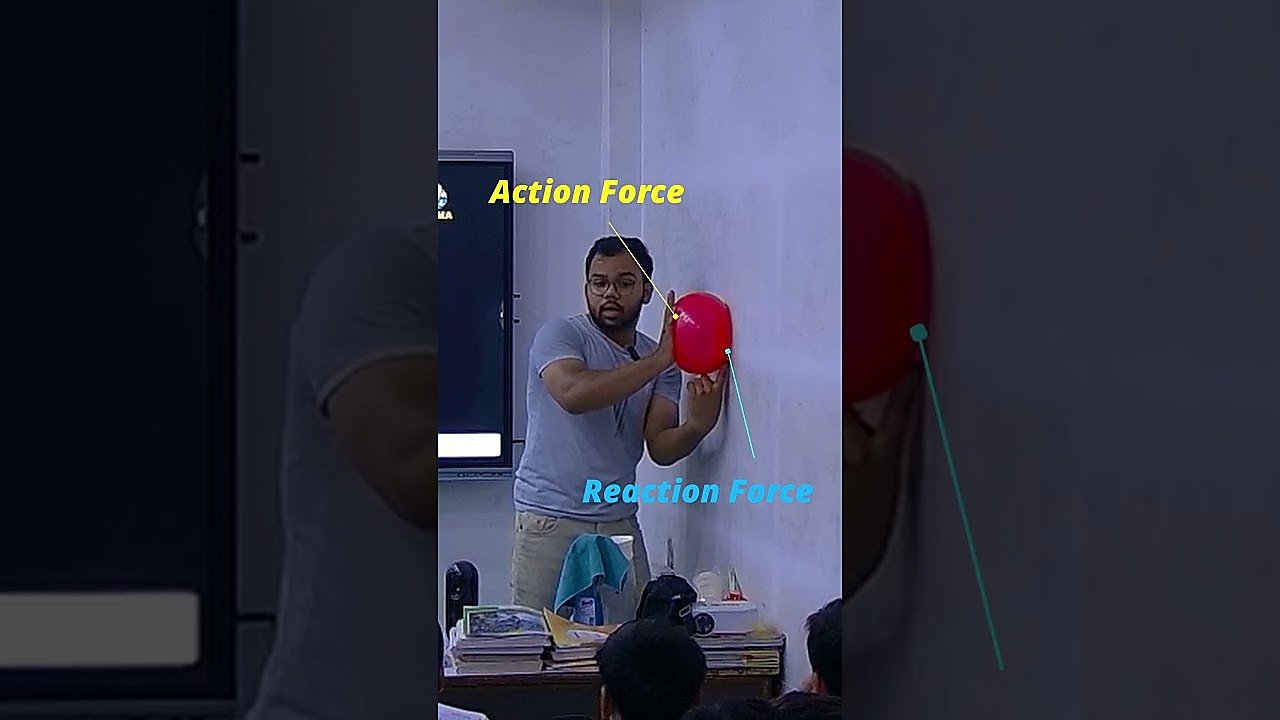
According to OpenStax University Physics Volume 1, forces always occur in pairs between 2 objects. A hand that pushes a wall with 40 N receives a push from the wall of 40 N in the opposite direction. The 2 forces form one interaction, and neither force exists without the other.
What Is Newton's Third Law of Motion?
Newton's third law of motion states that when one object exerts a force on a second object, the second object exerts a force of equal magnitude and opposite direction on the first object.
Isaac Newton published the law in 1687 in Philosophiæ Naturalis Principia Mathematica as Lex III, the third of 3 laws of motion. Textbooks give the law several equivalent names:
- Law of action and reaction
- Law of interaction
- Law of mutual forces
- Force pair law
What Is the Formula for Action and Reaction?
The formula for action and reaction is F_AB = −F_BA, where F_AB is the force of A on B and F_BA is the force of B on A. The magnitudes satisfy |F_AB| = |F_BA|.
The table lists 6 forms of the law and the meaning of each form.
| Form | Equation | Meaning |
|---|---|---|
| Vector form | F_AB = −F_BA | Equal magnitude, opposite direction |
| Magnitude form | |F_AB| = |F_BA| | Force sizes match in newtons (N) |
| Mass and acceleration | m_A a_A = −m_B a_B | Product of mass and acceleration matches for the 2 objects |
| Acceleration ratio | a_A/a_B = −m_B/m_A | The smaller mass has the larger acceleration |
| Momentum change | Δp_A = −Δp_B | Momentum gained by one object equals momentum lost by the other |
| Gravity pair | F = Gm₁m₂/r² on each object | Both objects feel the same force magnitude |
What Are the 5 Properties of an Action-Reaction Pair?
An action-reaction pair has 5 properties: equal magnitude, opposite direction, different objects, same force type, and simultaneous action.
- Equal magnitude: both forces have the same size in newtons.
- Opposite direction: the forces point along the same line in opposite senses.
- Different objects: each force acts on a different object.
- Same force type: both forces are gravitational, both are contact, or both are electromagnetic.
- Simultaneous action: the 2 forces appear and vanish together.
How to Identify an Action-Reaction Pair?
Identify a pair in 4 steps: name, swap, match, and separate.
- Name the force in the form "A exerts a force on B."
- Swap the objects to obtain "B exerts a force on A."
- Match the force type, which stays the same in both statements.
- Separate the objects, since the 2 forces appear in 2 different free-body diagrams.
Example: the force "Earth pulls the book down" pairs with "the book pulls Earth up." Both forces are gravitational, and they act on different objects.
What Are Examples of Action and Reaction Forces?
Examples of action and reaction include walking, swimming, rocket flight, bird flight, jumping, gun recoil, and collisions.
The table lists 12 situations, the action force, and the reaction force.
| Situation | Action Force | Reaction Force |
|---|---|---|
| Hand pushing a wall | Hand pushes the wall forward | Wall pushes the hand backward |
| Apple falling | Earth pulls the apple down | Apple pulls Earth up |
| Walking | Foot pushes the ground backward | Ground pushes the foot forward |
| Swimming | Hands push water backward | Water pushes the swimmer forward |
| Rocket in flight | Rocket pushes exhaust gas down | Exhaust gas pushes the rocket up |
| Bird in flight | Wings push air downward | Air pushes the bird upward |
| Jumping | Legs push the ground down | Ground pushes the legs up |
| Firing a rifle | Rifle pushes the bullet forward | Bullet pushes the rifle backward |
| Bat hitting a ball | Bat pushes the ball forward | Ball pushes the bat backward |
| Car accelerating | Tires push the road backward | Road pushes the tires forward |
| Moon orbiting Earth | Earth pulls the Moon | Moon pulls Earth |
| Magnet attracting iron | Magnet pulls the iron | Iron pulls the magnet |
Why Do Action and Reaction Forces Not Cancel?
Action and reaction forces do not cancel because they act on different objects, and only forces on the same object add in a net force.
A net force is the vector sum of forces on one object. The action acts on object B, and the reaction acts on object A. Each force appears in a different free-body diagram, so neither force reduces the other. Each object accelerates according to the net force on that object, F_net = ma.
What Is the Difference Between Action-Reaction Pairs and Balanced Forces?
Action-reaction pairs act on 2 different objects, and balanced forces act on 1 object and sum to zero.
The table compares the 2 concepts across 6 attributes.
| Attribute | Action-Reaction Pair | Balanced Forces |
|---|---|---|
| Objects involved | 2 different objects | 1 object |
| Net force effect | Does not cancel | Sums to 0 N on the object |
| Force type | Always the same type | Types may differ |
| Law | Newton's third law | Newton's first law with ΣF = 0 |
| Existence | Always occur together | Occur only in equilibrium |
| Example | Book pushes table, table pushes book | Weight and normal force on a book at rest |
Are Weight and Normal Force an Action-Reaction Pair?
No, weight and normal force are not an action-reaction pair, since both forces act on the same object and have different types. Weight is a gravitational force from Earth on the book. The normal force is a contact force from the table on the book.
The table lists the 2 true pairs for a book at rest on a table.
| Pair | Force on the Book | Paired Force on the Other Object |
|---|---|---|
| Gravity pair | Earth pulls the book down | Book pulls Earth up |
| Contact pair | Table pushes the book up | Book pushes the table down |
How Do Action and Reaction Affect Motion When Masses Differ?
Both objects feel the same force magnitude, and the object with less mass has the larger acceleration, since a = F/m.
The table lists the acceleration of 2 objects that interact through a 10 N force, with object A fixed at 1.0 kg.
| Mass of A (kg) | Mass of B (kg) | Acceleration of A (m/s²) | Acceleration of B (m/s²) |
|---|---|---|---|
| 1.0 | 1.0 | 10 | 10 |
| 1.0 | 5.0 | 10 | 2.0 |
| 1.0 | 10 | 10 | 1.0 |
| 1.0 | 100 | 10 | 0.10 |
| 1.0 | 5.972 × 10²⁴ (Earth) | 10 | 1.67 × 10⁻²⁴ |
The Earth-Moon pair shows the same effect. The gravitational force on each body is about 2.0 × 10²⁰ N. The Moon accelerates at 2.7 × 10⁻³ m/s², and Earth accelerates at 3.3 × 10⁻⁵ m/s².
How Is Newton's Third Law Linked to Conservation of Momentum?
Newton's third law implies conservation of momentum for an isolated 2-object system, in 5 steps.
- Write the third law: F_AB = −F_BA.
- Apply the second law to each object: F_AB = dp_B/dt and F_BA = dp_A/dt.
- Substitute into the third law: dp_B/dt = −dp_A/dt.
- Combine the terms: d(p_A + p_B)/dt = 0.
- Conclude that the total momentum p_A + p_B stays constant.
The result explains gun recoil, rocket motion, and collisions. Each object gains or loses momentum in equal and opposite amounts.
What Are Worked Examples of Action and Reaction?
The 9 worked examples apply the third law to gravity, pushes, recoil, collisions, rockets, walking, swimming, and boats. All examples use g = 9.81 m/s².
How Large Is the Force of an Apple on Earth?
Worked example 1: a 0.10 kg apple falls near Earth's surface.
- Force of Earth on the apple: W = 0.10 × 9.81 = 0.981 N down
- Force of the apple on Earth: 0.981 N up
- Acceleration of Earth: a = 0.981/(5.972 × 10²⁴) = 1.6 × 10⁻²⁵ m/s²
How Do 2 Skaters Move When They Push Apart?
Worked example 2: a 50 kg skater and a 70 kg skater push apart on frictionless ice with 60 N for 0.50 s.
- Acceleration of the 50 kg skater: 60/50 = 1.2 m/s²
- Acceleration of the 70 kg skater: 60/70 = 0.857 m/s² in the opposite direction
- Final speeds: 0.60 m/s and 0.43 m/s
- Momentum check: 50 × 0.60 = 30 kg·m/s and 70 × 0.43 = 30 kg·m/s in opposite directions
How Fast Does a Rifle Recoil?
Worked example 3: a 0.010 kg bullet leaves a 4.0 kg rifle at 400 m/s.
- Momentum of the bullet: 0.010 × 400 = 4.0 kg·m/s
- Recoil velocity of the rifle: −4.0/4.0 = −1.0 m/s
- Kinetic energy of the bullet: ½ × 0.010 × 400² = 800 J
- Kinetic energy of the rifle: ½ × 4.0 × 1.0² = 2.0 J
The momenta are equal in size, and the kinetic energies differ.
Which Vehicle Feels the Greater Force in a Collision?
Worked example 4: a 1,000 kg car and a 5,000 kg truck collide, with an impact force of 20,000 N.
- Force on the car: 20,000 N
- Force on the truck: 20,000 N in the opposite direction
- Acceleration of the car: 20,000/1,000 = 20 m/s²
- Acceleration of the truck: 20,000/5,000 = 4.0 m/s²
The forces are equal, and the car has 5 times the acceleration of the truck.
How Does a Rocket Use Action and Reaction?
A rocket pushes exhaust gas backward, and the gas pushes the rocket forward with a force called thrust. The thrust formula is F = v_e (dm/dt), where v_e is the exhaust speed relative to the rocket and dm/dt is the mass flow rate.
Worked example 5: a 20,000 kg rocket expels 100 kg/s of gas at 2,500 m/s.
- Thrust: F = 2,500 × 100 = 250,000 N
- Weight: 20,000 × 9.81 = 196,200 N
- Net force: 250,000 − 196,200 = 53,800 N upward
- Acceleration: 53,800/20,000 = 2.69 m/s²
The velocity gain of a rocket in free space is Δv = v_e ln(m₀/m₁). A mass ratio m₀/m₁ of 3 and v_e = 2,500 m/s give Δv = 2,500 × 1.099 = 2,746 m/s.
How Does Walking Use Action and Reaction?
Walking uses the reaction of friction, since the foot pushes backward on the ground and the ground pushes forward on the foot.
Worked example 6: a 70 kg person accelerates forward at 1.0 m/s².
- Net force on the person: 70 × 1.0 = 70 N forward
- Static friction from the ground on the foot: 70 N forward
- Force of the foot on the ground: 70 N backward
Earth's acceleration is negligible because of its mass. On ice, the maximum static friction drops, and the forward force from the ground drops with it.
How Fast Does a Swimmer Leave the Wall?
Worked example 7: a 60 kg swimmer pushes on a wall with 300 N for 0.40 s.
- Force of the wall on the swimmer: 300 N away from the wall
- Impulse: 300 × 0.40 = 120 N·s
- Speed after the push: 120/60 = 2.0 m/s
How Does a Person Jumping From a Boat Move the Boat?
Worked example 8: an 80 kg person jumps from a 200 kg boat at 2.0 m/s relative to the water, starting from rest. Water drag is negligible.
- Momentum of the person: 80 × 2.0 = 160 kg·m/s
- Boat velocity: −160/200 = −0.80 m/s
- Total momentum: 160 − 160 = 0 kg·m/s
What Is the Horse and Cart Paradox?
The horse and cart paradox asks why a cart moves when the cart pulls back on the horse with an equal force. The answer is that the 2 forces act on different objects, and the ground exerts a forward force on the horse.
Worked example 9: a 500 kg horse pulls a 200 kg cart. The ground pushes the horse forward with 1,000 N, and the cart has a rolling resistance of 200 N.
- Net force on the system: 1,000 − 200 = 800 N
- Acceleration: 800/700 = 1.14 m/s²
- Tension: T − 200 = 200 × 1.14, so T = 429 N
- Check on the horse: 1,000 − 429 = 571 N, which equals 500 × 1.14
The horse pulls the cart with 429 N, and the cart pulls the horse with 429 N. The net force on each object differs, and both accelerate at 1.14 m/s².
Does Newton's Third Law Apply to All Forces?
Newton's third law holds for contact forces and gravity in everyday mechanics, and it needs a field-momentum term in some electromagnetic cases.
The table lists 3 conditions and the adjustment for each.
| Condition | Effect on the Third Law | Adjustment |
|---|---|---|
| Central forces, such as gravity and static electric force | Strong form holds, with forces along the line between the objects | None |
| Magnetic forces between moving charges | Forces are not always along the line between the charges | Add momentum carried by the electromagnetic field |
| Interactions across large distances at high speeds | Finite signal speed delays force transmission | Use special relativity and field momentum |
The weak form states that the forces are equal and opposite. The strong form adds that the forces lie along the line between the 2 objects.
How Does the Third Law Relate to the First and Second Laws?
The first law covers zero net force, the second law relates net force to acceleration, and the third law describes the force pair between 2 objects.
| Attribute | First Law | Second Law | Third Law |
|---|---|---|---|
| Statement | Velocity stays constant when ΣF = 0 | F_net = ma | F_AB = −F_BA |
| Objects considered | 1 object | 1 object | 2 objects |
| Key concept | Inertia | Acceleration | Interaction |
| Example | Book at rest | Rocket at liftoff | Swimmer pushing off a wall |
What Is the History of Action and Reaction?
Newton published the law of action and reaction in 1687, after studies of collisions in the 1660s.
| Contributor | Period | Contribution |
|---|---|---|
| John Wallis, Christopher Wren, Christiaan Huygens | 1668 to 1669 | Published collision rules for the Royal Society |
| Isaac Newton | 1687 | Stated the law as Lex III in the Principia and tested it with pendulum collisions |
| Ernst Mach | 1883 | Linked the third law to the definition of mass through mutual accelerations |
| Richard Feynman | 1960s | Taught the third law within conservation of momentum in his lectures |
What Are the Applications of Action and Reaction?
Action and reaction apply in 6 fields: rocketry, aviation, marine propulsion, sports, firearm design, and robotics.
- Rocketry: engines expel gas, and the gas pushes the rocket with thrust.
- Aviation: jet engines accelerate air backward, and propellers push air backward.
- Marine propulsion: propellers push water backward, and oars push water backward.
- Sports: sprinters push starting blocks backward, and the blocks push sprinters forward.
- Firearm design: recoil pads and muzzle brakes manage the reaction of the projectile.
- Robotics: legged robots push the ground, and the ground reaction supplies the forward force.
What Are Common Misconceptions About Action and Reaction?
Common misconceptions involve cancellation, force size, timing, and the choice of objects.
| Misconception | Correct Statement |
|---|---|
| Action and reaction cancel | The forces act on different objects, so they do not cancel |
| A larger object exerts a larger force | Both objects exert equal force magnitudes |
| The action occurs first, and the reaction follows | Both forces appear at the same time |
| Weight and normal force form a pair | They act on the same object and have different types |
| Nothing moves if the forces are equal | Each object accelerates by F/m |
| Only moving objects exert reaction forces | Objects at rest exert reaction forces, such as a table pushing on a book |
| A pair can include 2 different force types | Both forces in a pair have the same type |
People Also Ask About Action and Reaction in Physics
What is the action and reaction law in physics?
Newton's third law states that when object A exerts a force on object B, object B exerts an equal and opposite force on object A.
What is the formula for action and reaction?
The formula is F_AB = −F_BA.
Do action and reaction forces cancel each other?
No, the forces act on different objects, so they do not cancel.
Are action and reaction forces equal in magnitude?
Yes, both forces have the same magnitude in newtons.
Do action and reaction forces act on the same object?
No, each force acts on a different object.
What is an example of action and reaction?
A swimmer pushes water backward, and the water pushes the swimmer forward.
Are weight and normal force an action-reaction pair?
No, both forces act on the same object, and they have different types.
What is the reaction force to gravity?
The reaction force to Earth's pull on an object is the object's pull on Earth.
Why does a rocket move forward?
The rocket pushes exhaust gas backward, and the gas pushes the rocket forward.
Why does a gun recoil?
The gun pushes the bullet forward, and the bullet pushes the gun backward with equal force.
Which object accelerates more in an interaction?
The object with less mass has the larger acceleration.
Is Newton's third law the same as conservation of momentum?
Newton's third law implies conservation of momentum for an isolated system.
Who discovered the law of action and reaction?
Isaac Newton published the law in 1687, building on collision studies by Wallis, Wren, and Huygens.
What is action and reaction in physics in one sentence?
Action and reaction are the equal and opposite forces that 2 interacting objects exert on each other.

The University of the West Indies
My passion as a teacher and leader in education is to contribute to students’ enhanced learning by creation of a positive teaching/learning environment, where they are motivated to develop strong critical thinking, analytical and problem-solving skills.
As acting Vice-Principal and head of Physics, I have amassed five years of experience in leading meetings, implementing strategies to maintain discipline and school ethos, liaise with stakeholders in planning for future development of the institution; successfully negotiated the implementation of various projects for student development as well as supervising effective execution of such. For the past 19 years, I have incorporated discovery learning within the classroom through practical activities, problem solving and cooperative learning and have realized that students retention in Physics and Mathematics have increased significantly.
I am always cognizant that students have different learning styles, and as such teaching strategies during planning and delivery must take this crucial factor into consideration and be tailored to meet such differences.