

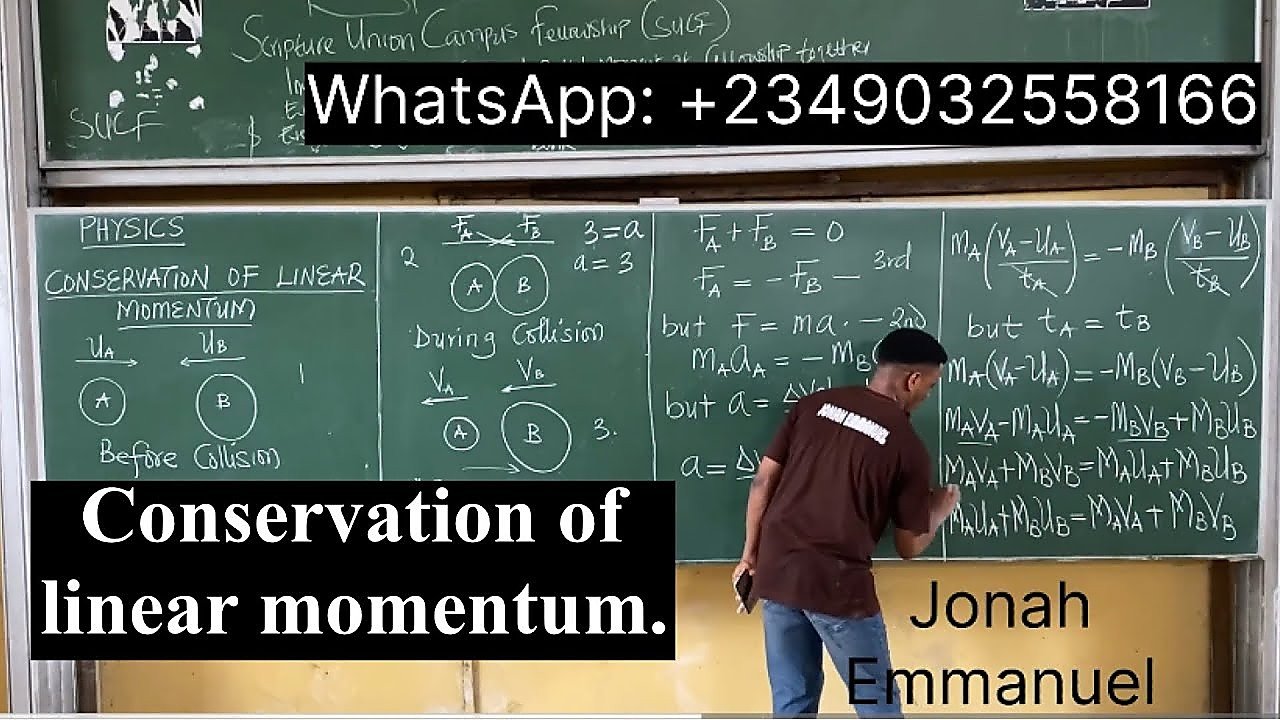
What Is the Law of Conservation of Momentum?
The law of conservation of momentum states that the total momentum of a system stays constant when the net external force on the system equals zero. NASA's Glenn Research Center states that the total momentum of a system before a collision equals the total momentum after the collision. The momentum of individual objects can change while the total remains the same.
For a reliable reference, consult OpenStax section on conservation of momentum.
Examples include colliding billiard balls, a recoiling rifle, and a launching rocket.
What Is Momentum?
Momentum is the product of an object's mass and velocity, written as p = mv. The SI unit of momentum is the kilogram meter per second (kg·m/s). Momentum is a vector, so it has both magnitude and direction. A 1,000 kg car moving at 20 m/s has a momentum of 20,000 kg·m/s.
What Is the Formula for the Law of Conservation of Momentum?
The formula is Σp_before = Σp_after, which becomes m₁u₁ + m₂u₂ = m₁v₁ + m₂v₂ for two objects. The table below defines each symbol with its SI unit.
| Symbol | Quantity | SI Unit |
|---|---|---|
| m₁, m₂ | Masses of object 1 and object 2 | kg |
| u₁, u₂ | Velocities before the collision | m/s |
| v₁, v₂ | Velocities after the collision | m/s |
| p | Momentum (p = mv) | kg·m/s |
Velocities carry signs: positive for one direction and negative for the opposite direction. The AP Physics 1 formula sheet lists p = mv and J = F_avg Δt = Δp with the connected mechanics equations.
Which Conditions Make Momentum Conserved in a System?
A system conserves momentum when the net external force on it equals zero. Two conditions satisfy this requirement:
- Isolated system: no external forces act on the objects.
- Short interaction time: the collision lasts so briefly that the impulse from any external force is negligible.
External forces include friction and applied pushes.
How Is the Law of Conservation of Momentum Derived From Newton's Laws?
The law follows from Newton's third law and the impulse-momentum theorem. The steps for two colliding objects are:
- Apply Newton's third law: the force of object 1 on object 2 equals the negative of the force of object 2 on object 1.
- Multiply both forces by the same contact time Δt to obtain equal and opposite impulses.
- Equate each impulse to the change in momentum: Δp₁ = -Δp₂.
- Add the changes: Δp₁ + Δp₂ = 0.
- Conclude that the total momentum p₁ + p₂ stays constant.
What Are the 3 Types of Collisions in Momentum Conservation?
The 3 collision types are elastic, inelastic, and perfectly inelastic, and all 3 conserve total momentum. The collision type affects how kinetic energy is divided, not the total momentum. The table below compares the types.
| Collision Type | Total Momentum | Total Kinetic Energy | Motion After Collision | Example |
|---|---|---|---|---|
| Elastic | Conserved | Conserved | Objects separate | Billiard balls (approximately) |
| Inelastic | Conserved | Decreases | Objects separate | Two cars that bounce apart |
| Perfectly inelastic | Conserved | Decreases by the maximum amount | Objects move together | Two carts that stick together |
How Do You Solve Momentum Conservation Problems?
Solve momentum conservation problems by equating the total momentum before and after the interaction. The steps are:
- Define the system and confirm that the net external force equals zero.
- Choose a positive direction.
- Write the total momentum before the interaction.
- Write the total momentum after the interaction.
- Solve the equation for the unknown velocity or mass.
What Are Examples of Momentum Conservation Problems?
Three solved examples show conservation in a perfectly inelastic collision, a recoil, and an elastic collision. The table below lists the given values and results, with momentum in kg·m/s.
| Scenario | Total Momentum Before | Total Momentum After | Result |
|---|---|---|---|
| Perfectly inelastic: a 1,000 kg car at 20 m/s hits a stationary 1,000 kg car, and the cars stick together | 1,000 × 20 + 1,000 × 0 = 20,000 | 2,000 × v = 20,000 | v = 10 m/s; kinetic energy falls from 200,000 J to 100,000 J |
| Recoil: a 0.005 kg bullet at 400 m/s leaves a 4 kg rifle at rest | 0 | 0.005 × 400 + 4 × v_rifle = 0 | v_rifle = -0.5 m/s, a backward recoil of 0.5 m/s |
| Elastic: a 2 kg ball at 3 m/s hits a stationary 2 kg ball head-on | 2 × 3 + 2 × 0 = 6 | 2 × 0 + 2 × 3 = 6 | The balls exchange velocities |
How Does Momentum Conservation Work in Two Dimensions?
In two dimensions, momentum is conserved separately along the x-axis and the y-axis, because momentum is a vector. The two equations are:
- Σp_x,before = Σp_x,after
- Σp_y,before = Σp_y,after
Examples include collisions at road intersections and glancing collisions between billiard balls.
What Are Real-Life Applications of the Law of Conservation of Momentum?
The law applies to 5 common situations:
- Rocket propulsion: the total momentum of a rocket and its fuel is zero before launch, so exhaust gas gains backward momentum while the rocket gains forward momentum.
- Firearm recoil: the bullet's forward momentum balances the gun's backward momentum.
- Vehicle collisions: investigators calculate pre-crash speeds from post-crash motion.
- Billiards: balls transfer momentum to each other on impact.
- Space walks: astronauts that collide in space exchange momentum, and the total stays constant.
Who Discovered the Law of Conservation of Momentum?
René Descartes proposed the first version in 1644, and John Wallis, Christopher Wren, and Christiaan Huygens corrected it in 1668. Descartes used a conserved quantity based on speed, which is a scalar. The 1668 Royal Society papers by Wallis and Wren showed that the conserved quantity is the vector momentum. Newton's third law later supplied the derivation from his laws of motion.
How Does Conservation of Momentum Differ From Conservation of Energy?
Momentum is conserved in every collision of an isolated system, while kinetic energy is conserved only in elastic collisions. The lost kinetic energy converts into thermal energy, sound, and deformation. The table below compares the two quantities.
| Feature | Momentum | Kinetic Energy |
|---|---|---|
| Formula | p = mv | K = ½mv² |
| Quantity type | Vector | Scalar |
| SI unit | kg·m/s | J |
| Elastic collision | Conserved | Conserved |
| Inelastic collision | Conserved | Not conserved |
| Perfectly inelastic collision | Conserved | Not conserved |
Why Is Momentum Conserved According to Symmetry in Physics?
Momentum is conserved because the laws of physics are the same at every position in space, a property called space translation symmetry. Time translation symmetry produces energy conservation in the same way. Noether's theorem, published by Emmy Noether in 1918, states this link between symmetries and conservation laws.
What Is the Summary of the Law of Conservation of Momentum?
The law of conservation of momentum states that the total momentum of an isolated system stays constant. The formula is m₁u₁ + m₂u₂ = m₁v₁ + m₂v₂. The law holds for 3 collision types and follows from Newton's third law.
People Also Ask: What Do Students Ask About the Law of Conservation of Momentum?
What is the law of conservation of momentum in simple terms?
The total momentum of objects that interact only with each other stays the same before and after the interaction.
What is the formula for conservation of momentum?
The formula is m₁u₁ + m₂u₂ = m₁v₁ + m₂v₂ for two objects.
Is momentum conserved in an inelastic collision?
Yes, momentum is conserved in an inelastic collision while kinetic energy decreases.
What is the SI unit of momentum?
The SI unit of momentum is the kilogram meter per second (kg·m/s).
When is momentum not conserved?
Momentum is not conserved when a net external force, such as friction or an applied push, acts on the system.
What is the difference between impulse and momentum?
Momentum equals mass times velocity, while impulse equals force times time and equals the change in momentum.
Does conservation of momentum apply to explosions?
Yes, the total momentum of the fragments equals the momentum of the object before the explosion, which is zero for an object at rest.
Does conservation of momentum hold in special relativity?
Yes, total momentum is conserved in special relativity when relativistic momentum is used.

The University of the West Indies
My passion as a teacher and leader in education is to contribute to students’ enhanced learning by creation of a positive teaching/learning environment, where they are motivated to develop strong critical thinking, analytical and problem-solving skills.
As acting Vice-Principal and head of Physics, I have amassed five years of experience in leading meetings, implementing strategies to maintain discipline and school ethos, liaise with stakeholders in planning for future development of the institution; successfully negotiated the implementation of various projects for student development as well as supervising effective execution of such. For the past 19 years, I have incorporated discovery learning within the classroom through practical activities, problem solving and cooperative learning and have realized that students retention in Physics and Mathematics have increased significantly.
I am always cognizant that students have different learning styles, and as such teaching strategies during planning and delivery must take this crucial factor into consideration and be tailored to meet such differences.