

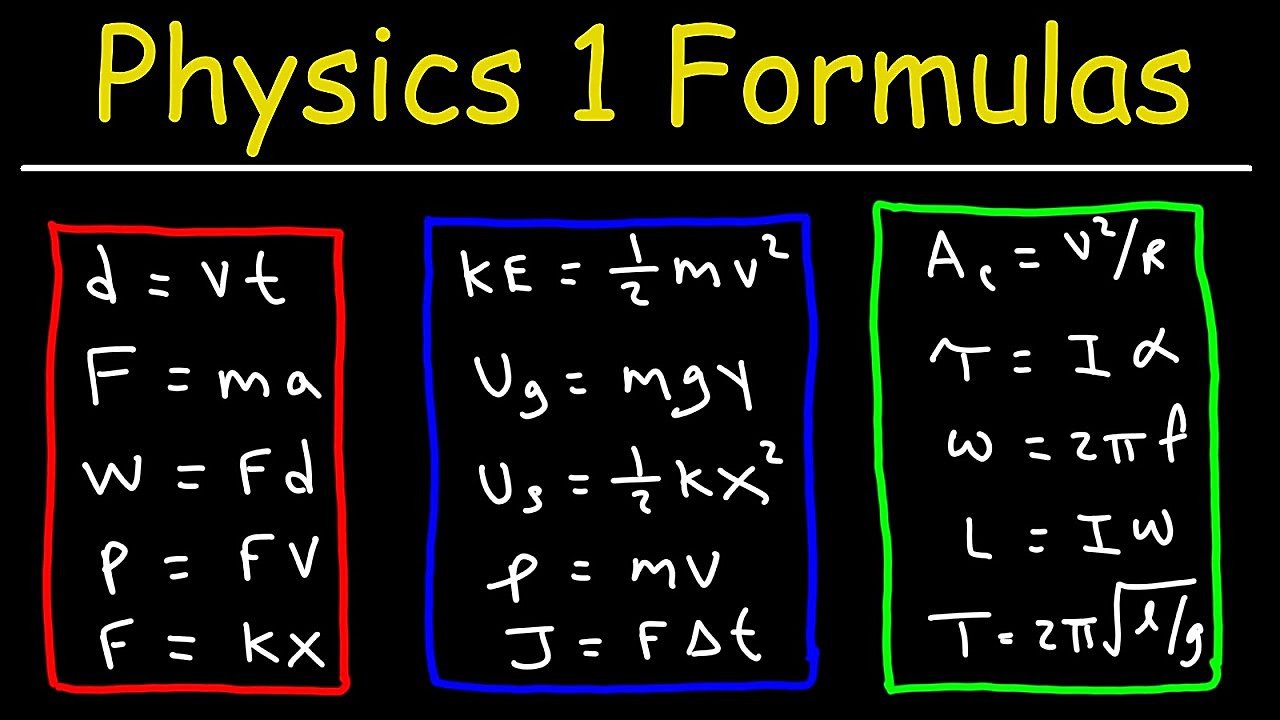
What Is the AP Physics 1 Formula Sheet?
The AP Physics 1 formula sheet is a College Board reference document that lists equations, constants, prefixes, unit symbols, and trigonometric values for the exam. The College Board titles it Exam Reference Information.
For a reliable reference, consult College Board AP Physics 1 course information.
The sheet contains 7 components:
- Constants
- Prefixes
- Unit symbols
- Trigonometric values for common angles
- Exam conventions
- Geometry and trigonometry formulas
- Mechanics and fluids equations
The exam conventions state 4 assumptions: inertial frames of reference, negligible air resistance, ideal springs and strings, and ideal fluids in completely filled pipes. These assumptions apply unless a problem states otherwise.
Does the AP Physics 1 Exam Provide a Formula Sheet?
Yes, the College Board provides the reference information to students during the exam. The printed sheet allows scratch work in blank space, and proctors collect it at the end.
College Board guidance states that students cannot bring their own copies of the tables to the exam room.
Where Can Students Find the Official AP Physics 1 Formula Sheet PDF?
The official PDF is hosted on the College Board's AP Central website. The file is named ap-physics-1-equations-sheet.pdf and sits at apcentral.collegeboard.org/media/pdf/ap-physics-1-equations-sheet.pdf. The current edition carries a 2025 College Board copyright.
The College Board notes that tables can be revised and directs students to the AP Physics course pages on AP Central for the latest versions.
What Constants Does the AP Physics 1 Formula Sheet Include?
The sheet includes 4 constants: the universal gravitational constant, 1 atmosphere of pressure, gravitational acceleration, and gravitational field strength. The table below shows each constant with its symbol and listed value.
| Constant | Symbol | Value on the Sheet |
|---|---|---|
| Universal gravitational constant | G | 6.67 × 10⁻¹¹ m³/(kg·s²) |
| 1 atmosphere of pressure | 1 atm | 1.0 × 10⁵ Pa |
| Acceleration due to gravity at Earth's surface | g | 9.8 m/s² |
| Gravitational field strength at Earth's surface | g | 9.8 N/kg |
Which Prefixes Does the Formula Sheet List?
The sheet lists 9 metric prefixes from tera (10¹²) to pico (10⁻¹²). The table below pairs each prefix with its symbol and factor.
| Prefix | Symbol | Factor |
|---|---|---|
| tera | T | 10¹² |
| giga | G | 10⁹ |
| mega | M | 10⁶ |
| kilo | k | 10³ |
| centi | c | 10⁻² |
| milli | m | 10⁻³ |
| micro | μ | 10⁻⁶ |
| nano | n | 10⁻⁹ |
| pico | p | 10⁻¹² |
Which Unit Symbols Does the Formula Sheet List?
The sheet lists 8 unit symbols: hertz (Hz), joule (J), kilogram (kg), meter (m), newton (N), pascal (Pa), second (s), and watt (W).
Which Trigonometric Values Does the Formula Sheet List?
The sheet lists sine, cosine, and tangent values for 7 angles: 0°, 30°, 37°, 45°, 53°, 60°, and 90°. The table below shows each value.
| Angle (θ) | sin θ | cos θ | tan θ |
|---|---|---|---|
| 0° | 0 | 1 | 0 |
| 30° | 1/2 | √3/2 | √3/3 |
| 37° | 3/5 | 4/5 | 3/4 |
| 45° | √2/2 | √2/2 | 1 |
| 53° | 4/5 | 3/5 | 4/3 |
| 60° | √3/2 | 1/2 | √3 |
| 90° | 1 | 0 | undefined |
What Equations Are on the AP Physics 1 Formula Sheet?
The sheet lists mechanics and fluids equations under one heading, Mechanics and Fluids. The sections below group the equations by the 8 course units: Kinematics, Force and Translational Dynamics, Work, Energy, and Power, Linear Momentum, Torque and Rotational Dynamics, Energy and Momentum of Rotating Systems, Oscillations, and Fluids.
Which Equations Cover Unit 1 Kinematics?
Unit 1 Kinematics relies on 3 equations for motion with constant acceleration. These equations apply only when acceleration is constant.
| Equation | Relationship Described | Variable Definitions |
|---|---|---|
| vₓ = vₓ₀ + aₓt | Final velocity from initial velocity, acceleration, and time | v = velocity, a = acceleration, t = time |
| x = x₀ + vₓ₀t + ½aₓt² | Position from initial position, initial velocity, acceleration, and time | x = position |
| vₓ² = vₓ₀² + 2aₓ(x – x₀) | Final velocity from acceleration and displacement | x₀ = initial position |
Which Equations Cover Unit 2 Force and Translational Dynamics?
Unit 2 covers Newton's second law, friction, circular motion, spring force, and gravitation.
| Equation | Relationship Described | Variable Definitions |
|---|---|---|
| a = ΣF/m = F_net/m | Newton's second law | a = acceleration, F = force, m = mass |
| |F_f| ≤ μ|F_n| | Maximum friction force | μ = coefficient of friction, F_n = normal force |
| a_c = v²/r | Centripetal acceleration | v = speed, r = radius |
| |F_s| = k|x| | Spring force | k = spring constant, x = displacement |
| |F_g| = Gm₁m₂/r² | Gravitational force between two masses | G = gravitational constant, r = separation |
| g = F_g/m | Gravitational field strength | g = field strength |
Which Equations Cover Unit 3 Work, Energy, and Power?
Unit 3 covers kinetic energy, work, power, and 3 forms of potential energy.
| Equation | Relationship Described | Variable Definitions |
|---|---|---|
| K = ½mv² | Kinetic energy | K = kinetic energy |
| ΔE = W = F∥d = Fd cos θ | Work as change in energy | E = energy, W = work, d = distance, θ = angle |
| P = ΔE/Δt | Power | P = power, t = time |
| ΔU_g = mgΔy | Change in gravitational potential energy near Earth | U = potential energy, y = vertical position |
| U_s = ½kx² | Spring potential energy | k = spring constant |
| U_G = -Gm₁m₂/r | Gravitational potential energy between two masses | r = separation |
Which Equations Cover Unit 4 Linear Momentum?
Unit 4 covers momentum, impulse, and center-of-mass velocity.
| Equation | Relationship Described | Variable Definitions |
|---|---|---|
| p = mv | Linear momentum | p = momentum |
| J = F_avg Δt = Δp | Impulse and change in momentum | J = impulse, F_avg = average force |
| v_cm = Σp_i/Σm_i = Σm_iv_i/Σm_i | Center-of-mass velocity | v_cm = center-of-mass velocity |
Which Equations Cover Unit 5 Torque and Rotational Dynamics?
Unit 5 covers rotational kinematics, torque, and Newton's second law for rotation.
| Equation | Relationship Described | Variable Definitions |
|---|---|---|
| θ = θ₀ + ω₀t + ½αt² | Angular position under constant angular acceleration | θ = angular position, ω = angular speed, α = angular acceleration |
| ω = ω₀ + αt | Angular speed under constant angular acceleration | t = time |
| α = Στ/I = τ_net/I | Newton's second law for rotation | τ = torque, I = rotational inertia |
| τ = r⊥F = rF sin θ | Torque from a force | r = distance from the axis, F = force |
Which Equations Cover Unit 6 Energy and Momentum of Rotating Systems?
Unit 6 covers angular momentum, angular impulse, and rotational kinetic energy.
| Equation | Relationship Described | Variable Definitions |
|---|---|---|
| L = Iω | Angular momentum | L = angular momentum, I = rotational inertia, ω = angular speed |
| ΔL = τΔt | Angular impulse and change in angular momentum | τ = torque, t = time |
| K = ½Iω² | Rotational kinetic energy | K = kinetic energy |
Which Equations Cover Unit 7 Oscillations?
Unit 7 covers position in simple harmonic motion, period, frequency, and the periods of springs and pendulums.
| Equation | Relationship Described | Variable Definitions |
|---|---|---|
| x = A cos(2πft) | Position of an oscillator | A = amplitude, f = frequency, t = time |
| T = 2π/ω = 1/f | Period, angular speed, and frequency | T = period, ω = angular speed |
| T_s = 2π√(m/k) | Period of a mass on a spring | m = mass, k = spring constant |
| T_p = 2π√(ℓ/g) | Period of a simple pendulum | ℓ = length, g = gravitational field strength |
Which Equations Cover Unit 8 Fluids?
Unit 8 covers density, pressure, buoyancy, continuity, and Bernoulli's equation.
| Equation | Relationship Described | Variable Definitions |
|---|---|---|
| ρ = m/V | Density | ρ = density, m = mass, V = volume |
| P = F/A | Pressure | P = pressure, F = force, A = area |
| P = P₀ + ρgh | Pressure at depth h | P₀ = pressure at the surface, h = depth |
| |F_b| = ρVg | Buoyant force | V = displaced volume |
| A₁v₁ = A₂v₂ | Continuity equation | A = cross-sectional area, v = fluid speed |
| P + ρgy + ½ρv² = constant | Bernoulli's equation | y = vertical position |
Which Geometry and Trigonometry Formulas Does the Formula Sheet Provide?
The sheet provides formulas for 6 shapes and 1 right triangle. The shapes are the rectangle, triangle, circle, rectangular solid, cylinder, and sphere. Rectangle and triangle areas apply to areas under graphs, such as a velocity-time graph.
| Shape | Formula | Quantity Calculated |
|---|---|---|
| Rectangle | A = bh | Area |
| Triangle | A = ½bh | Area |
| Circle | A = πr² | Area |
| Circle | C = 2πr | Circumference |
| Rectangular solid | V = ℓwh | Volume |
| Cylinder | V = πr²ℓ | Volume |
| Cylinder | S = 2πrℓ + 2πr² | Surface area |
| Sphere | V = 4/3 πr³ | Volume |
| Sphere | S = 4πr² | Surface area |
| Right triangle | c² = a² + b² | Hypotenuse and sides |
| Right triangle | sin θ = a/c, cos θ = b/c, tan θ = a/b | Trigonometric ratios |
In the right triangle, c is the hypotenuse, a is the side opposite angle θ, and b is the side adjacent to angle θ.
What Changed on the AP Physics 1 Formula Sheet With the Fluids Unit?
The sheet added fluids equations when the course added Unit 8 Fluids in the 2024-25 school year. The equations section carries the title Mechanics and Fluids. The Table of Information lists the pascal and 1 atmosphere to support pressure calculations.
Earlier editions listed additional constants, including proton mass, speed of light, electron charge magnitude, and the Coulomb's law constant. The 2025 edition lists 4 constants.
Which Equations Are Not on the AP Physics 1 Formula Sheet?
Not every equation in the AP Physics 1 course framework appears on the formula sheet. The College Board lists the equations available to students in the Table of Information: Equations, located in the appendix of the Course and Exam Description.
The College Board states that the tables do not include every equation that a problem might use.
How Does the AP Physics 1 Formula Sheet Compare With the AP Physics 2 Formula Sheet?
The AP Physics 1 sheet lists 4 constants, while the AP Physics 2 sheet lists constants such as Avogadro's number, the Boltzmann constant, and Planck's constant. Both sheets share the universal gravitational constant, 1 atmosphere of pressure, and the gravitational field strength at Earth's surface.
How Can Students Use the AP Physics 1 Formula Sheet Effectively?
Students use the sheet effectively by matching known and unknown quantities to the correct equation. The steps below apply to practice problems and exam questions.
- Identify the unit that the problem covers, such as kinematics or fluids.
- List the known values and the quantity to find.
- Match the variables to an equation in the matching unit group.
- Check units against the unit symbols and prefixes on the sheet.
- Compare the setup with the exam conventions, such as negligible air resistance.
Practice with the official PDF before the exam builds familiarity with equation locations.
Do Students Need to Memorize AP Physics 1 Equations?
Memorizing every equation is not required because the College Board provides the sheet. The sheet lists equations without stating when each one applies. Students recall conditions of use, such as constant acceleration for the 3 kinematic equations, and the meaning of each symbol.
What Is the Summary of the AP Physics 1 Formula Sheet?
The AP Physics 1 formula sheet is a 7-component College Board reference that covers 8 course units. It lists 4 constants, 9 prefixes, 8 unit symbols, 7 trigonometric angles, 4 exam conventions, geometry formulas for 6 shapes, and mechanics and fluids equations.
People Also Ask: What Do Students Ask About the AP Physics 1 Formula Sheet?
Is a formula sheet provided for AP Physics 1?
Yes, the College Board provides reference information with equations, constants, and tables during the exam.
Can students bring a personal formula sheet to the AP Physics 1 exam?
College Board guidance states that students cannot bring their own copies of the tables to the exam room.
What value of g appears on the AP Physics 1 formula sheet?
The sheet lists g as 9.8 m/s² for acceleration and 9.8 N/kg for gravitational field strength.
Does the AP Physics 1 formula sheet include fluids equations?
Yes, the equations section is titled Mechanics and Fluids.
Where is the official AP Physics 1 formula sheet PDF?
The official PDF is on the College Board's AP Central website under the AP Physics 1 resources.
How many constants are on the AP Physics 1 formula sheet?
The 2025 sheet lists 4 constants: G, 1 atmosphere, g in m/s², and g in N/kg.
Does the AP Physics 1 formula sheet include electricity equations?
The 2025 sheet lists no electricity constants, and its equations section is titled Mechanics and Fluids.

The University of the West Indies
My passion as a teacher and leader in education is to contribute to students’ enhanced learning by creation of a positive teaching/learning environment, where they are motivated to develop strong critical thinking, analytical and problem-solving skills.
As acting Vice-Principal and head of Physics, I have amassed five years of experience in leading meetings, implementing strategies to maintain discipline and school ethos, liaise with stakeholders in planning for future development of the institution; successfully negotiated the implementation of various projects for student development as well as supervising effective execution of such. For the past 19 years, I have incorporated discovery learning within the classroom through practical activities, problem solving and cooperative learning and have realized that students retention in Physics and Mathematics have increased significantly.
I am always cognizant that students have different learning styles, and as such teaching strategies during planning and delivery must take this crucial factor into consideration and be tailored to meet such differences.
3 Comments
Pingback: Displacement Definition in Physics: Formula, SI Unit, Vector Properties, and Examples
Pingback: Centripetal Force vs Centrifugal Force: 7 Differences, Formulas, and Examples
Pingback: Law of Conservation of Momentum: Definition, Formula, 3 Collision Types, and Examples